


Enquire Form
How Clear Aligners Move Teeth: The Science Behind Every Step
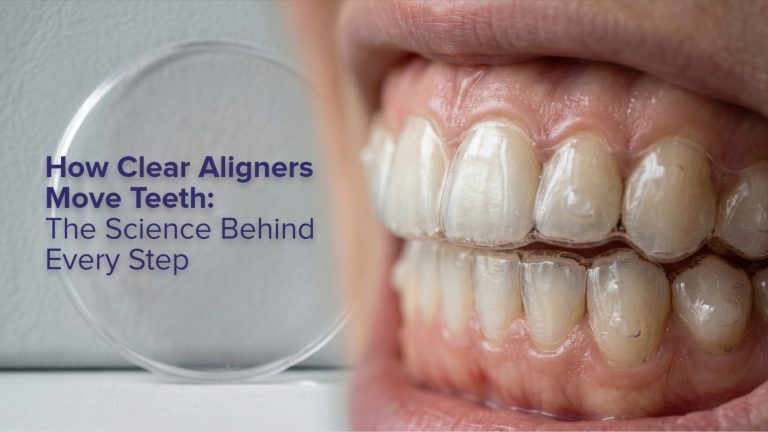
Clear aligners are not anything that does not follow biology of orthodontic force. Though they have changed the way orthodontic treatment was seen and delivered till this time.
Clear aligners may have considered as treatment modality for mild to moderate cases but now have evolved into a full-fledged sophisticated way to treat complex cases as well.
Even though there are a lot of supportive advancements behind the clear aligner therapy, the root science is the same for the way these orthodontic appliances work. Digital treatment planning, AI-driven portals and smile simulations, and modern manufacturing technologies do not go against the biological principle of controlled force and tooth movement.
Every aligner, attachment, and treatment stage is designed to deliver precise orthodontic forces that stimulate bone absorption, remodeling, reformation and finally guide teeth toward their planned position.
Understanding of this sensitive process is essential not only for orthodontists but also for aligner manufacturers and dental laboratories striving to improve treatment predictability.
The Biology Behind Tooth Movement
Teeth do not move because aligners physically push them through bone. Instead, they move because the body responds to orthodontic forces by remodeling the surrounding bone.
Because of the orthodontic force, the periodontal ligament (PDL) experiences compression on one side and tension on the other.
This creates a biological response that includes:
- Bone resorption on the pressure side
- Bone deposition on the tension side
- Remodeling of the periodontal ligament
Gradual movement of the tooth through the alveolar bone
Biological Response to Orthodontic Force
| Area | Biological Activity | Outcome |
| Compression Side | Osteoclast activation | Bone resorption |
| Tension Side | Osteoblast activation | Bone formation |
| Periodontal Ligament | Cellular remodeling | Tooth movement |
| Alveolar Bone | Continuous adaptation | Stable repositioning |
This biological mechanism is identical whether treatment is performed using braces or clear aligners.
The difference lies in how force is delivered.
How Clear Aligners Generate Force
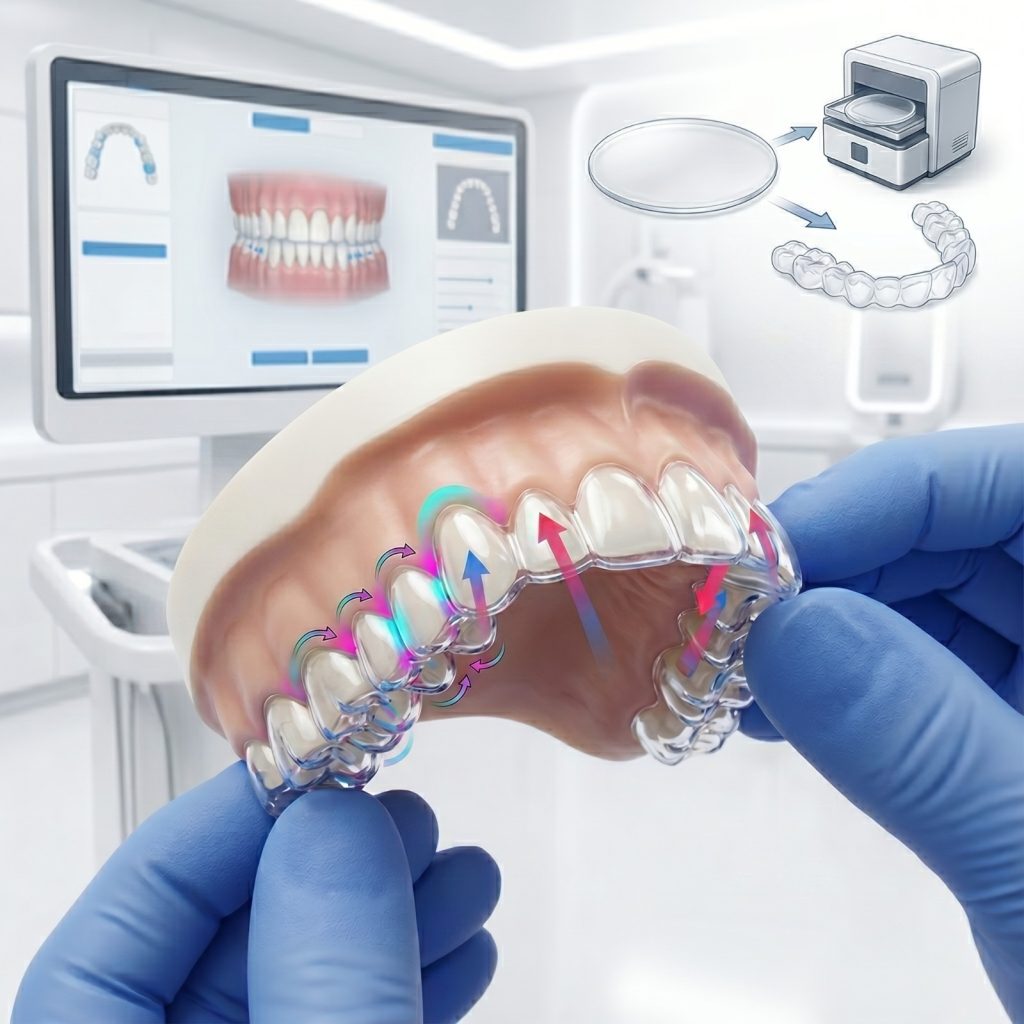
Unlike fixed appliances, which rely on brackets and arch wires, aligners generate force through elastic deformation.
Each aligner is manufactured to represent a slightly different tooth position than the patient’s current dentition. When the aligner is inserted, it does not fit perfectly.
That small mismatch creates stress within the aligner material.
As the material attempts to return to its original shape, force is applied to specific teeth.
The process can be simplified into four stages:
- Aligner insertion
- Force generation through elastic deformation
- Biological response within the PDL and bone
- Tooth movement toward the programmed position
Once the movement is achieved, the patient progresses to the next aligner.
Aligners vs Fixed Appliances
Both systems rely on the same biological principles, but their biomechanics differ
significantly.
| Parameter | Fixed Appliances | Clear Aligners |
| Force Delivery | Continuous | Intermittent |
| Esthetics | Limited | Excellent |
| Oral Hygiene | More challenging | Easier |
| Patient Compliance | Less dependent | Highly dependent |
| Force Decay | Minimal | Higher |
| Comfort | Moderate | Generally higher |
This difference in force delivery makes material performance particularly important in aligner therapy.
Why Small Movements Matter
One of the reasons aligners achieve predictable outcomes is that movement is distributed across multiple stages.
Most systems are designed to move teeth in small increments.
Typical Movement Per Aligner
| Movement Type | Typical Increment |
| Translation | 0.20–0.30 mm |
| Rotation | 1–3° |
| Intrusion | 0.10–0.25 mm |
| Extrusion | 0.10–0.25 mm |
| Torque | Small controlled increments |
Attempting excessive movement in a single stage often leads to poor tracking and increased refinement rates.
Not All Tooth Movements Are Equal.
Some tooth movements respond exceptionally well to aligner therapy, while others remain biomechanically challenging.
Predictability of Tooth Movements
| Movement | Predictability |
| Mild Tipping | High |
| Crowding Correction | High |
| Space Closure | High |
| Expansion | Moderate to High |
| Rotation of Round Teeth | Moderate |
| Extrusion | Moderate |
| Root Torque | Challenging |
| Bodily Translation | Challenging |
Understanding these limitations helps clinicians create more realistic treatment plans and helps manufacturers design more effective aligner systems.
Why Attachments Are Essential
Attachments are often viewed as simple composite additions, but biomechanically they play a critical role in aligner therapy.
Without attachments, aligners primarily engage smooth tooth surfaces, limiting their ability to generate complex force systems.
Attachments improve:
- Retention
- Rotational control
- Root movement
- Extrusion efficiency
- Force direction
Clinical Benefits of Attachments
| Function | Benefit |
| Retention | Better aligner seating |
| Rotation Control | Improved derotation |
| Extrusion Support | Better vertical movement |
| Root Control | Enhanced torque expression |
| Anchorage | Greater biomechanical stability |
In many cases, attachments are the difference between acceptable movement and predictable movement.
The Importance of Aligner Material
Material science plays a much larger role in aligner success than many clinicians realize.
The ideal aligner material must maintain force throughout the wear cycle while resisting deformation and preserving dimensional accuracy. Taglus aligners sheets are certified and provide the desired properties that not only give a brilliant outcome only but also good prognosis.
Material Properties That Influence Performance
| Property | Clinical Impact |
| Elastic Modulus | Determines stiffness |
| Shape Memory | Supports force recovery |
| Stress Relaxation | Influences force retention |
| Flexural Strength | Prevents deformation |
| Transparency | Improves patient acceptance |
| Dimensional Stability | Maintains fit accuracy |
Material performance directly affects treatment predictability, particularly in more demanding cases.
Understanding Force Decay
Unlike arch wires, aligners do not deliver constant force indefinitely.
Immediately after insertion, force levels are at their highest. Over time, stress relaxation causes those forces to decrease.
Typical Force Profile
| Time | Force Level |
| Immediately After Insertion | Highest |
| Day 2–3 | Moderate |
| Day 5–7 | Reduced |
| End of Wear Cycle | Lowest |
This is why force retention is such an important consideration when selecting aligner materials and manufacturing protocols. Want to understand more about force decay? Click here
What Causes Tracking Loss?
Tracking refers to how accurately the teeth follow the planned digital setup.
When tracking is ideal, aligners fit completely and tooth movement proceeds according to plan.
When tracking is lost, treatment becomes less predictable.
Common Causes of Tracking Failure
| Cause | Clinical Impact |
| Poor Wear Compliance | Delayed movement |
| Force Decay | Reduced effectiveness |
| Inaccurate Staging | Biological lag |
| Material Deformation | Poor aligner fit |
| Inadequate Attachments | Reduced control |
Signs of tracking loss may include aligner gaps, incomplete seating, attachment disengagement, and increased refinement requirements.
Why Staging Determines Success
Staging is the process of distributing tooth movements throughout the aligner sequence.
The most successful aligner treatments are not necessarily those that move teeth the fastest. They are the ones that respect biological limitations while maximizing biomechanical efficiency.
Conservative vs Aggressive Staging
| Factor | Conservative Staging | Aggressive Staging |
| Tracking | Better | Reduced |
| Predictability | Higher | Lower |
| Refinements | Fewer | More |
| Treatment Speed | Slower | Faster Planned Timeline |
The goal is not simply movement. The goal is predictable movement.
Looking Ahead
The future of aligner therapy will be shaped by advances in material science, thermoforming precision, and digital treatment planning.
Manufacturers like TAGLUS who are envisioned towards providing a niche clear aligner dependency are increasingly focused on:
- Unmatched force retention
- Multilayer materials
- Enhanced shape-memory behaviour
- Better thermoforming accuracy
- Greater dimensional stability
- Designs like dual masking for better results beyond material science
As aligner systems continue to evolve, the relationship between biomechanics and material performance will become even more important.
Conclusion
Clear aligners may appear simple, but the science behind them is anything but simple.
Every successful treatment depends on a delicate balance between biology, biomechanics, material science, and digital planning. The aligner delivers the force, the body performs the remodeling, and the treatment plan guides the process.
Understanding these principles is essential for improving treatment predictability and achieving consistently successful outcomes.
Because in aligner therapy, moving teeth is not just about plastic. It is about delivering the right force, at the right time, in the right way.
Have Questions?
 Talk to us on WhatsApp
Know More About Us
SignUp To Our Newsletter And Get To Know More About Taglus

Taglus is the global industry leader in the manufacturing of innovative clear Aligner and retainer thermoplastic sheets.

Copyrights@taglus-2026
*Taglus is a trademark of Vedia Solutions
Leave a Reply