


Enquire Form
Is Your Aligner Material Actually Certified? What Orthodontists Should Ask Their Supplier
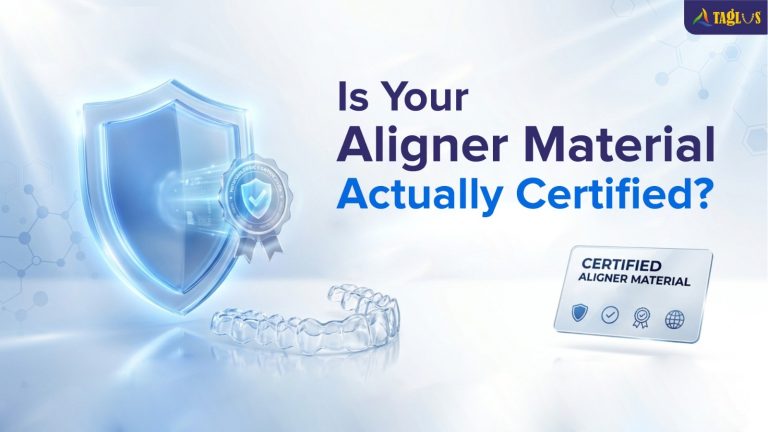
“Medical-grade” “FDA-cleared” “Biocompatible” These phrases appear on nearly every aligner material sheet in the market. But phrases on a sheet aren’t the same as documentation in a file, and the gap between the two can matter a great deal when a patient asks a pointed question, or when a regulatory audit lands on your desk.
Aligner material certification isn’t a marketing checkbox. It’s a paper trail that proves a specific polymer, in a specific formulation, has been tested and cleared for prolonged contact inside the human mouth. As an orthodontist or lab, you’re not just trusting your supplier’s word but you’re extending that trust directly to your patients. That makes it worth knowing exactly what to ask for, and why.
Why “Certified” Can Mean Very Different Things
Certification is not one standard, it’s a stack of them, and suppliers are expected to clarify which ones they’ve actually met.
Regulatory clearance confirms a material has gone through a formal review process with a body like the US FDA or India’s CDSCO, establishing it’s safe for its intended use. This is the baseline, not the ceiling.
Biocompatibility testing, typically under ISO 10993, evaluates a material for cytotoxicity, sensitization, and irritation, the practical question of whether it will harm soft tissue over weeks of continuous wear. A material can be regulatory-cleared in a broad category without every batch being tested to this standard.
USP Class VI is a related but distinct designation, focused on toxicological response to plastics used in medical devices. Some suppliers cite this as though it’s interchangeable with ISO 10993, it isn’t, and asking which one applies to your material is a fair question.
Manufacturing quality standards, such as ISO 13485, certify the production process and quality management system, not the material itself. A supplier can have excellent process certification while sourcing a polymer that hasn’t been independently retested for the aligner use case.
None of this is meant to suggest that most suppliers are cutting corners. It’s meant to highlight that “certified” is a word doing a lot of work on a label, and orthodontists are well within their rights to ask which specific certification is being claimed. Four Questions Worth Asking Every Aligner Supplier
Most conversations about aligner material safety stop at “it’s certified.” That’s not a wrong answer, but it’s an incomplete one. Here’s what’s actually worth asking, and what the paperwork should look like when a supplier can back it up.
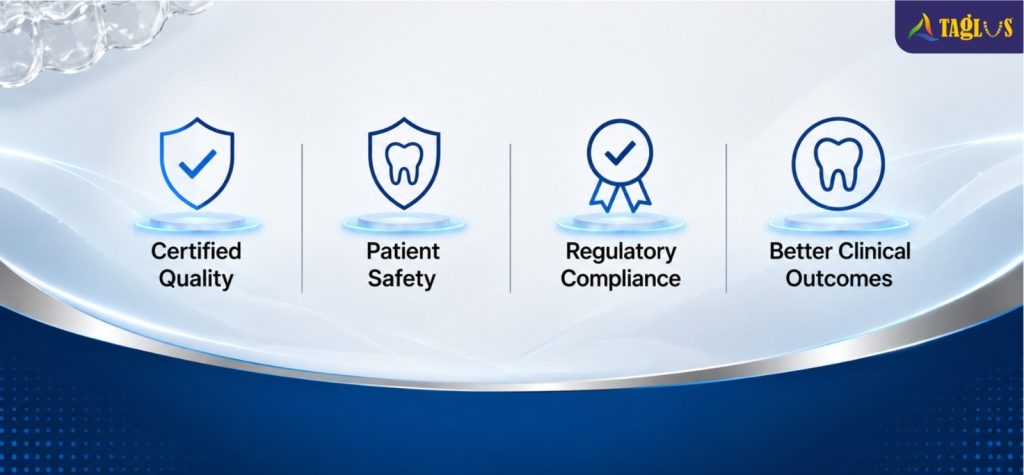
- Which regulatory clearances apply to this exact material, and can you show the certificates? Not the company. Not the product line. The specific polymer formulation you’re prescribing. A supplier with nothing to hide will name the certifying bodies without hesitation. Taglus holds ISO 13485:2016, CE, UKCA, TGA, and ANVISA RUS certifications, and manufactures out of an FDA-registered facility, so this is a one-line email away, not a negotiation.
- Where’s the biocompatibility data, not just the assurance? “Biocompatible material” on a spec sheet means little without a lab report behind it. Ask for the actual testing standard and results. Taglus material carries ISO 10993 biocompatibility certification, along with independent tensile and durability testing (ASTM D638) verified by a NABL-accredited laboratory operating under ISO/IEC 17025. That’s the difference between a claim and a documented result.
- Is the material sourced and tested consistently across batches? Quiet substitution between batches, often for cost or supply reasons, can undermine certification claims made about an earlier formulation. This is really a question about the supplier’s quality system as a whole. ISO 13485:2016 exists precisely to answer it: it’s the standard that governs batch traceability, supplier qualification, and change control, not just the finished product.
- If something goes wrong, can this documentation be handed to a patient or an auditor on request? This is the practical test. A supplier confident in their paperwork won’t stall when asked to produce it in a form a patient or regulator can actually read. If the answer is hesitation, that’s information too.
Why This Matters Beyond Compliance
Patients are asking more informed questions in consultations than they used to, and “is this safe” increasingly comes with a follow-up: “how do you know?” Being able to answer with documentation, not just reassurance, is what builds the trust that drives referrals and case acceptance.
For labs, the stakes are sharper. You sit between the material supplier and the treating clinician, which means any gap in documentation becomes your liability as much as anyone’s.
The good news: this level of transparency isn’t hard to get. A supplier with genuinely certified materials welcomes the question, because the paperwork already exists. See Taglus’s full certifications at taglus.com/certificates-and-registeration.
Where Taglus Stands
At Taglus, our aligner materials are backed by verifiable regulatory clearance and biocompatibility documentation, because we believe the orthodontists and labs we work with go beyond them to the end customer that is patients and authenticity is the only things makes us go ahead .
Visit www.taglus.com to learn more about our certified aligner materials and manufacturing standards.
Have Questions?
 Talk to us on WhatsApp
Know More About Us
SignUp To Our Newsletter And Get To Know More About Taglus

Taglus is the global industry leader in the manufacturing of innovative clear Aligner and retainer thermoplastic sheets.

Copyrights@taglus-2026
*Taglus is a trademark of Vedia Solutions
Leave a Reply