


Enquire Form
Force Decay in Aligners – Understanding the Clinical Impact
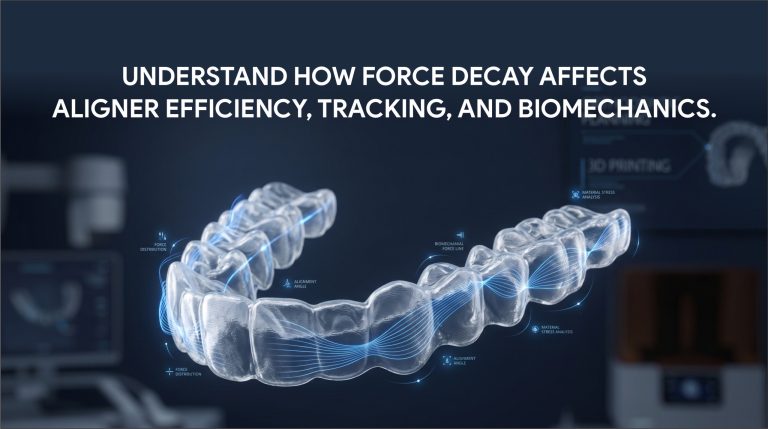
Force decay is one of the most underestimated variables in aligner therapy. While treatment plans assume consistent force delivery, actual clinical performance often differs.
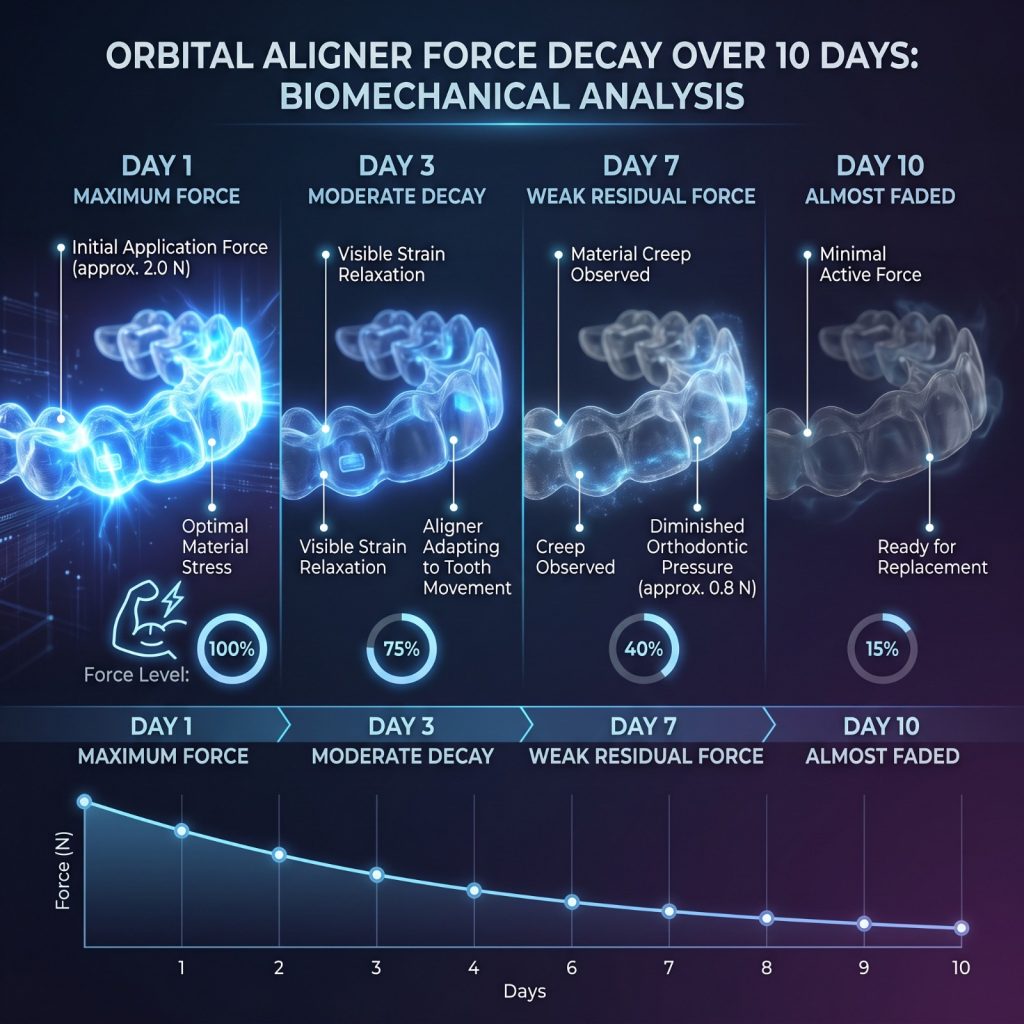
If the aligner does not deliver the same force on Day 10 as it did on Day 1, treatment efficiency drops.
What is Force Decay
Force decay refers to the reduction in force exerted by the aligner over time due to material relaxation and deformation.
Force Behavior Over Time
| Day | Force Level (Typical) |
| Day 1 | 100% |
| Day 3 | 70–80% |
| Day 7 | 50–60% |
| Day 10 | 30–40% |
This reduction impacts tooth movement efficiency.
Why Force Decay Happens
Material Science Perspective
| Cause | Explanation | Clinical Effect |
| Stress relaxation | Polymer chains lose tension | Reduced force |
| Water absorption | Material softens | Loss of stiffness |
| Thermal changes | Oral environment variation | Altered properties |
| Plastic deformation | Permanent shape change | Poor fit |
Clinical Consequences of Force Decay
Aligner therapy depends on the delivery of controlled and continuous biomechanical forces. When force levels reduce too quickly, the programmed tooth movement is not fully expressed. This affects tracking accuracy, movement predictability, and overall treatment efficiency. In many cases, excessive force decay becomes a major contributor to refinements and mid-course corrections.
| Issue | Outcome |
| Reduced force delivery | Slower movement |
| Incomplete expression | Tracking loss |
| Extended treatment time | More aligners needed |
| Increased refinements | Additional cost and time |
Biomechanical Implications
When aligner materials undergo rapid force decay, the force delivered to the tooth falls below the biologically effective range. This interrupts the continuity of movement and compromises the expression of planned biomechanics. As a result, clinicians may observe incomplete tracking, delayed movement, or loss of control over complex tooth movements.
| Force Type | Clinical Impact |
| Continuous | Predictable movement |
| Intermittent | Delayed response |
| Low force | Ineffective movement |
| High force | Risk of root resorption |
Aligner Material Performance Comparison
The clinical efficiency of aligner therapy is closely linked to material performance. Factors such as force retention, elastic recovery, dimensional stability, and resistance to deformation directly influence tracking accuracy and movement predictability. Materials with unstable mechanical properties may lose force rapidly, resulting in incomplete tooth movement and increased refinements.
| Parameter | Low-Quality Materials | High-Performance Materials |
| Initial force | High | Controlled |
| Force decay | Rapid | Gradual |
| Fit stability | Reduces | Maintained |
| Efficiency | Low | High |
Clinical Strategies to Manage Force Decay
1. Select High-Performance Materials
Material choice directly impacts force stability.
Taglus aligner sheets are developed for stable force retention, supporting effective movement throughout the prescribed wear period.
2. Optimize Aligner Change Protocol
| Protocol | Impact |
| 7-day change | Maintains force efficiency |
| 10–14 day change | Increased decay risk |
3. Reinforce Patient Compliance
| Wear Duration | Force Effectiveness |
| <16 hours | Poor |
| 18–20 hours | Moderate |
| 20–22 hours | Optimal |
4. Monitor Fit and Adaptation
| Indicator | Meaning |
| Gaps in aligner | Loss of tracking |
| Loose fit | Force decay impact |
| Attachment mismatch | Inefficient force transfer |
Material Properties That Matter
| Property | Importance |
| Elastic modulus | Determines force level |
| Stress relaxation rate | Indicates decay speed |
| Recovery rate | Maintains aligner shape |
| Transparency stability | Indicates structural integrity |
Taglus Material Advantage
| Feature | Clinical Benefit |
| Stable force retention | Consistent tooth movement |
| High elastic recovery | Better fit over time |
| Reduced deformation | Improved tracking |
| Optimized stiffness | Balanced force delivery |
Clinical Workflow to Minimize Force Decay Impact
| Step | Action |
| Case selection | Avoid complex movements in single stage |
| Material choice | Use stable force-retaining sheets |
| Wear protocol | Enforce 20–22 hours |
| Monitoring | Check fit regularly |
| Adjustment | Modify plan if tracking deviates |
Summary Pointers
- Force decay reduces aligner effectiveness over time
- Most materials lose significant force within the first week
- Continuous force is essential for predictable tooth movement
- Material properties determine clinical outcomes
- Poor force retention leads to refinements and delays
- High-performance materials like Taglus improve treatment consistency
In a nutshell
Aligner success depends not just on planning, but on how long the material can deliver effective force. Taglus materials ensure force stability across the wear cycle, improving predictability, and reducing treatment inefficiencies.
Have Questions?
 Talk to us on WhatsApp

Know More About Us
SignUp To Our Newsletter And Get To Know More About Taglus

Taglus is the global industry leader in the manufacturing of innovative clear Aligner and retainer thermoplastic sheets.

Copyrights@taglus-2026
*Taglus is a trademark of Vedia Solutions
Leave a Reply