


Enquire Form
Clear Aligner vs Clear Retainer: The Material Difference Most Practices Discover Only After a Relapse Case
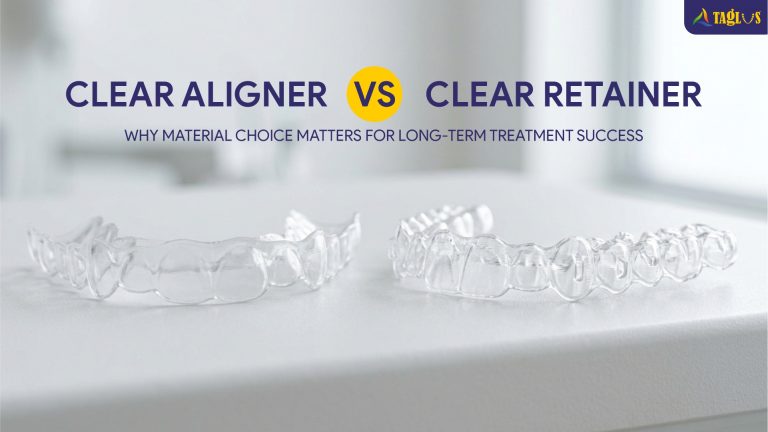
To a patient, a clear aligner and a clear retainer look like the same object at two different points in a story. Both are thin, transparent, thermoformed shells that fit over the dentition. Both arrive from a lab, in a small case, worn for a specified number of hours. It’s entirely reasonable for a patient to assume a retainer is simply “the last aligner, kept on repeat.” We understand why many practices have let that assumption stand uncorrected correcting it has not, historically, seemed worth the chairside time.
The cases where this assumption becomes a problem are relapse cases. And in our experience manufacturing both appliance types at scale, by the time a practice is looking at a relapsed arch, the root cause is often not patient non-wear at all. It’s a material asked to do the wrong job.
This is a distinction we build into every order at Taglus, and it’s one we think more practices should be asking about.
Two Materials, Two Mechanical Jobs
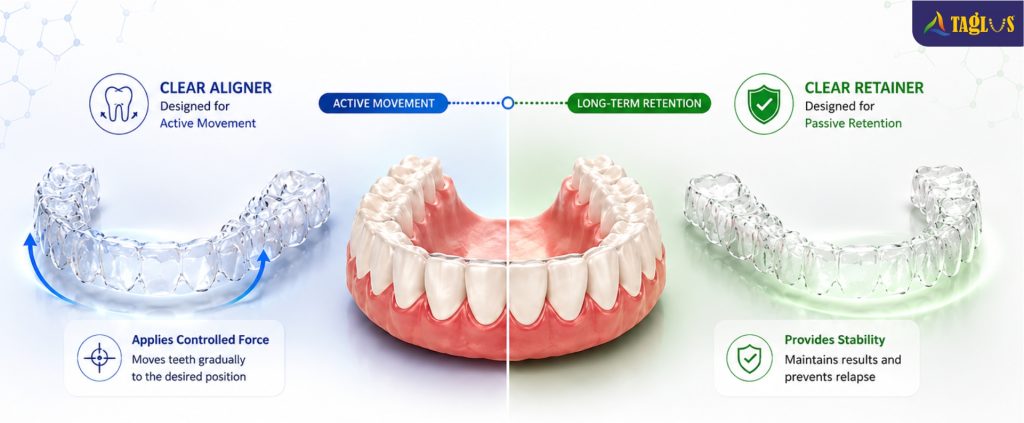
We don’t manufacture clear aligners and clear retainers with the same formulation, because we’re not building them to do the same thing.
Aligners are engineered to apply sustained, controlled force. The material needs enough rigidity and elastic memory to hold a shape that is deliberately different from the current tooth position, and to keep exerting force toward that target shape over roughly one to two weeks of wear before the next stage takes over. This is why we manufacture our active aligners from stiffer, higher-modulus multi-layer thermoplastics engineered specifically to resist relaxing back toward the current tooth position too quickly. A material too flexible for this job will relax against the teeth within days and stop producing meaningful movement — mechanically indistinguishable, to the tooth, from a patient simply not wearing it.
Retainers are engineered to do the opposite: apply passive, stabilizing force. A retainer’s job is to hold teeth in their final, already-achieved position and resist the physiological drift that continues for months to years after active treatment ends and not to move anything further. That calls for a material prioritized for long-term dimensional stability and resistance to permanent deformation under extended, often nightly-only wear, rather than for progressive force delivery. Our retainer material line is selected and processed with that specific job in mind, durability over years of insertion and removal, not elastic memory tuned for a two-week stage cycle. To know more about our retainer material click here
Using an aligner-grade material for long-term retention, or a retainer-grade material for active movement, isn’t a cosmetic mismatch. It’s a mechanical one and it tends to show up months later as relapse.
Where We See This Go Wrong Across the Industry
The “just keep wearing the last tray” shortcut. Some practices, to save a lab order and an appointment, instruct patients to continue wearing their final active aligner stage as an informal retainer. In the short term this can appear to work, since that final tray is already closely matched to the achieved position. What it doesn’t account for is durability: aligner-grade material isn’t built for months or years of repeated insertion and removal, and it was fabricated for the pre-retention tooth position not the small settling movements that occur in the weeks immediately after active treatment ends. As the material fatigues and the teeth settle, that “retainer” becomes progressively less accurate, often silently, until a retention check reveals drift.
Sourcing retainers on price alone. Because retainers look simple, they’re frequently the appliance most likely to get shopped to the lowest bidder, without much scrutiny of what material or process is behind the quote. A retainer produced from a thin, generic single-layer sheet on a basic vacuum-forming setup can look identical in the case to a properly engineered retention appliance — and behave nothing like it over a multi-year retention period.
Refinement trays mislabelled as retainers. In cases requiring refinement, what’s needed is a light-force active aligner and not a passive retainer for the interim stage. If that order gets treated as true retention rather than active refinement, the material and staging won’t match the clinical intent, and the case can plateau instead of completing the planned movement. This is one of the reasons we ask practices to specify treatment intent explicitly on every retention-stage order, rather than defaulting to a generic “retainer” line item.
In each of these scenarios, the patient did everything asked of them. The failure sits upstream in a material specification that didn’t match the mechanical job the appliance needed to do.
What We Build into Every Order
We treat “clear aligner” and “clear retainer” as genuinely different products, not variations on a theme distinguished only by which stage of treatment a patient happens to be in. In practice, that means:
- A distinct material line for active aligners versus retention appliances and never one formulation stretched across both use cases.
- Treating the transition from active treatment to retention as its own prescription event on our manufacturing side, so a retainer order is never quietly fulfilled as a leftover aligner stage.
- Consistent fit tolerances on retainers engineered for multi-year wear, not just first-fit accuracy.
For practices, the patient-facing fix is a single sentence worth saying out loud at the end of every case: your retainer is not your last aligner it’s a different appliance, built from a different material, doing a different job. Patients who hear this are markedly more likely to treat retainer replacement as routine maintenance rather than an unexpected cost, and far less likely to press an old, worn aligner back into service when a retainer goes missing.
The Underlying Point
Relapse gets diagnosed, after the fact, as a compliance failure the patient didn’t wear their retainer enough. Sometimes that’s true. But a meaningful share of relapse cases traces back not to hours of wear, but to a material substitution made months earlier, quietly, at the lab order stage an aligner-grade or under-specified material asked to do a retainer’s job.
That’s not a conversation about patient behaviour. It’s a conversation about what a practice is asking its manufacturing partner to produce, and whether the material behind the plastic matches the mechanical task in front of it. It’s also exactly the conversation we’d welcome with any practice reviewing their current aligner and retention protocols.
Have Questions?
 Talk to us on WhatsApp
Know More About Us
SignUp To Our Newsletter And Get To Know More About Taglus

Taglus is the global industry leader in the manufacturing of innovative clear Aligner and retainer thermoplastic sheets.

Copyrights@taglus-2026
*Taglus is a trademark of Vedia Solutions
Leave a Reply