


Enquire Form
Why Surface Finish Matters in 3D Printed Orthodontic Models
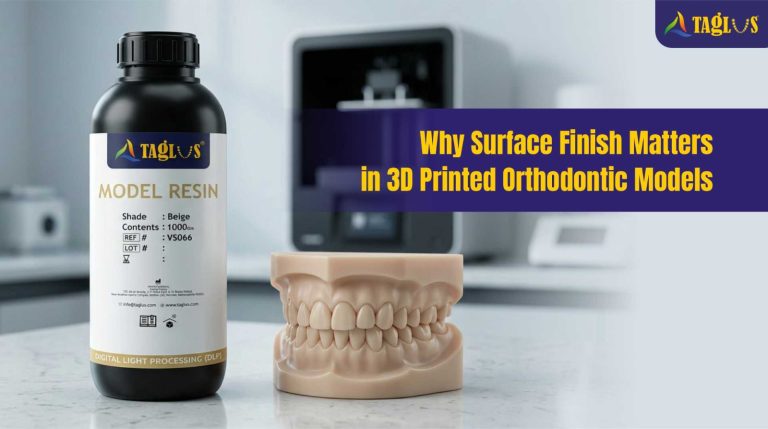
To someone outside a dental lab, a 3D printed orthodontic model can look like a finished product the moment it comes off the printer. The shape is there. The teeth are there. The digital design has become a physical model. It is easy to assume that if the geometry is accurate, the job is done.
In production, it isn’t.
The surface of that model becomes part of everything that happens next. It influences how the thermoforming sheet adapts, how consistently the appliance is produced, and how much finishing a technician needs to do. All of this ultimately decides how predictable the manufacturing process will become.
That is why we don’t look at surface finish as a cosmetic detail at Taglus. We look at it as part of the model quality.
A Model Is More Than Its Geometry
A digital orthodontic model can be extremely precise.
But when it is converted into a physical model through 3D printing, the final result is influenced by much more than the original CAD file.
Layer height, print orientation, resin behavior, exposure settings, washing, curing, and post-processing. All of these can influence the surface that eventually comes into contact with the thermoforming material.
Two models can represent the same digital anatomy and still have varying results during production because their physical surfaces are not the same.
And that distinction matters.
A model with visible layer lines, rough areas, unsupported regions or inconsistent finishing may still look acceptable on a workstation. But once a sheet is thermoformed over it, those imperfections can become part of the manufacturing outcome.
Where Surface Finish Becomes a Production Issue
The first issue is adaptation.
When a thermoforming sheet is heated and formed over a printed model, the material needs to reproduce the geometry of that model as consistently as possible.
A rough or uneven surface introduces another variable.
Instead of the process being primarily about reproducing the intended anatomy, the sheet is also responding to surface irregularities created during printing and finishing.
The second issue is consistency.
In a single case, a small surface imperfection can be negligible.
Across hundreds or thousands of models, it becomes a production variable.
For a lab running a digital workflow at scale, consistency is the objective. The model should not behave differently from case to case simply because one print has more pronounced layer lines or a slightly different post-processing result.
That is where surface quality stops being an aesthetic consideration and becomes a manufacturing consideration.
The Thermoforming Step Does Not Hide a Poor Model
A common assumption is that, since the thermoforming sheet is going to cover the model, it will hide the imperfections on the model surface.
The opposite can be true.
The thermoforming process reproduces the model.
If the model has an inconsistent surface, the thermoforming sheet reproduces those inconsistencies.
A smoother, more uniform model provides a more controlled surface for the thermoforming process.
This does not mean that a perfectly smooth model automatically guarantees a perfect appliance. Thermoforming depends on several variables, including material characteristics, temperature, pressure, machine settings, and model accuracy.
But surface finish is one variable that can be controlled.
And in a production environment, controllable variables matter.
The Cost of “Good Enough”
The challenge with surface finish is that poor quality is rarely dramatic.
A model may not fail outright.
Instead, the consequences appear as small inefficiencies:
- Additional manual finishing
- More time spent correcting imperfections
- Inconsistent thermoforming results
- Variation between models
- Greater dependence on technician intervention
- More opportunities for downstream errors
None of these necessarily stop production.
But collectively, they can make a digital workflow less predictable.
That is the difference between a model that is simply printed and a model that is production ready.
What Actually Determines Surface Finish?
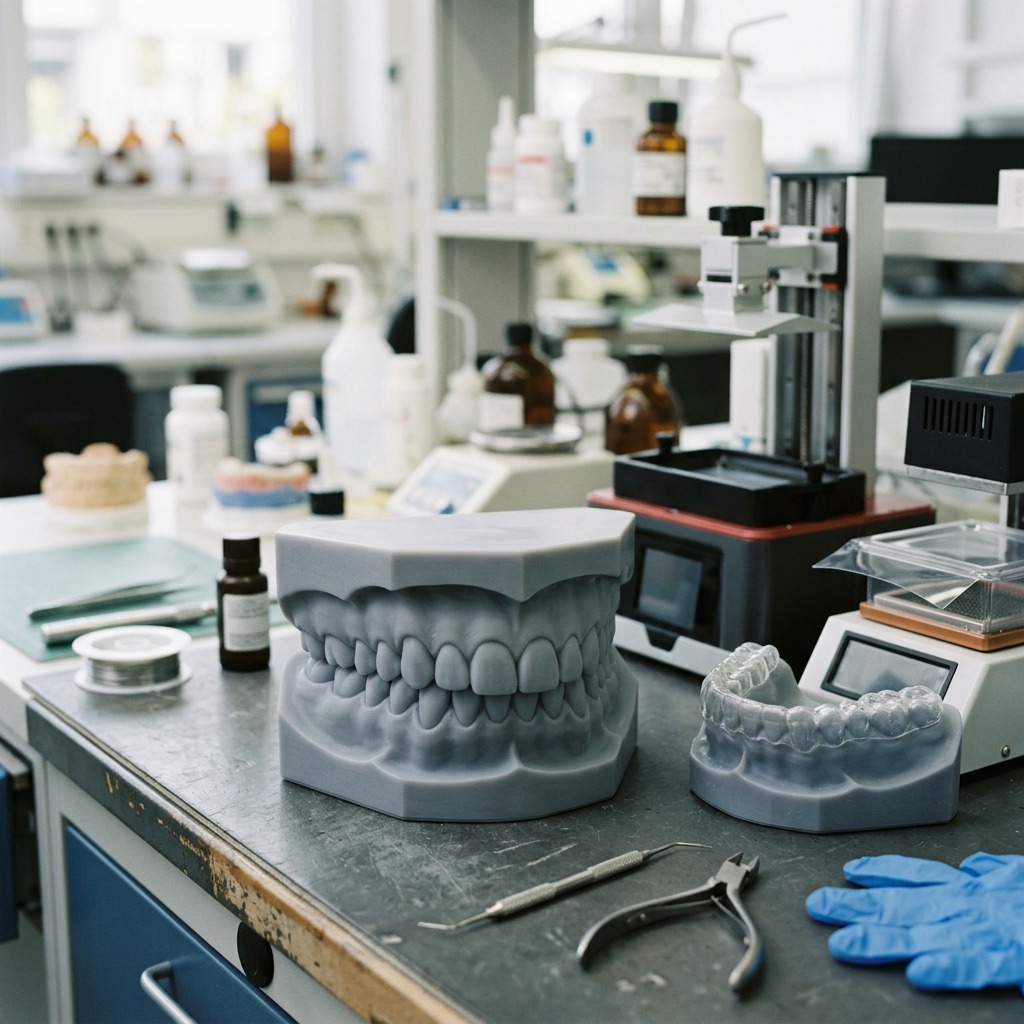
None of the settings create a high-quality surface on its own. It is the result of the entire printing process.
Print Resolution
Layer height has a direct relationship with how visible the individual printed layers become.
Finer layers can enable a smoother representation of curved surfaces and detailed anatomy, but the choice of this parameter is not universal and depends on the particular printer, resin, and production requirements.
Print Orientation
The way a model is positioned during printing can influence where layer lines, supports, and surface artefacts appear.
Moreover, optimal orientations are not universal for different geometries.
Resin Performance
A critical factor affecting the surface finish is the resin itself.
A model resin needs to reproduce fine anatomical details while maintaining dimensional stability throughout printing and post-processing.
Inconsistent resin behaviour can translate into inconsistent model surfaces.
Washing and Curing
The print does not become a finished model when it leaves the printer.
Washing removes residual material, while curing establishes the final properties of the printed part.
Inadequate curing or incorrect washing can negatively impact the final model’s quality.
Post-Processing
Support removal, sanding, and other finishing steps can improve the appearance of a model, but excessive or inconsistent finishing also has the potential to damage the model’s details.
The objective should not simply be to make the model look smooth.
The objective is to achieve a consistent surface without compromising the geometry that the model is supposed to reproduce.
Surface Finish and the Digital Workflow
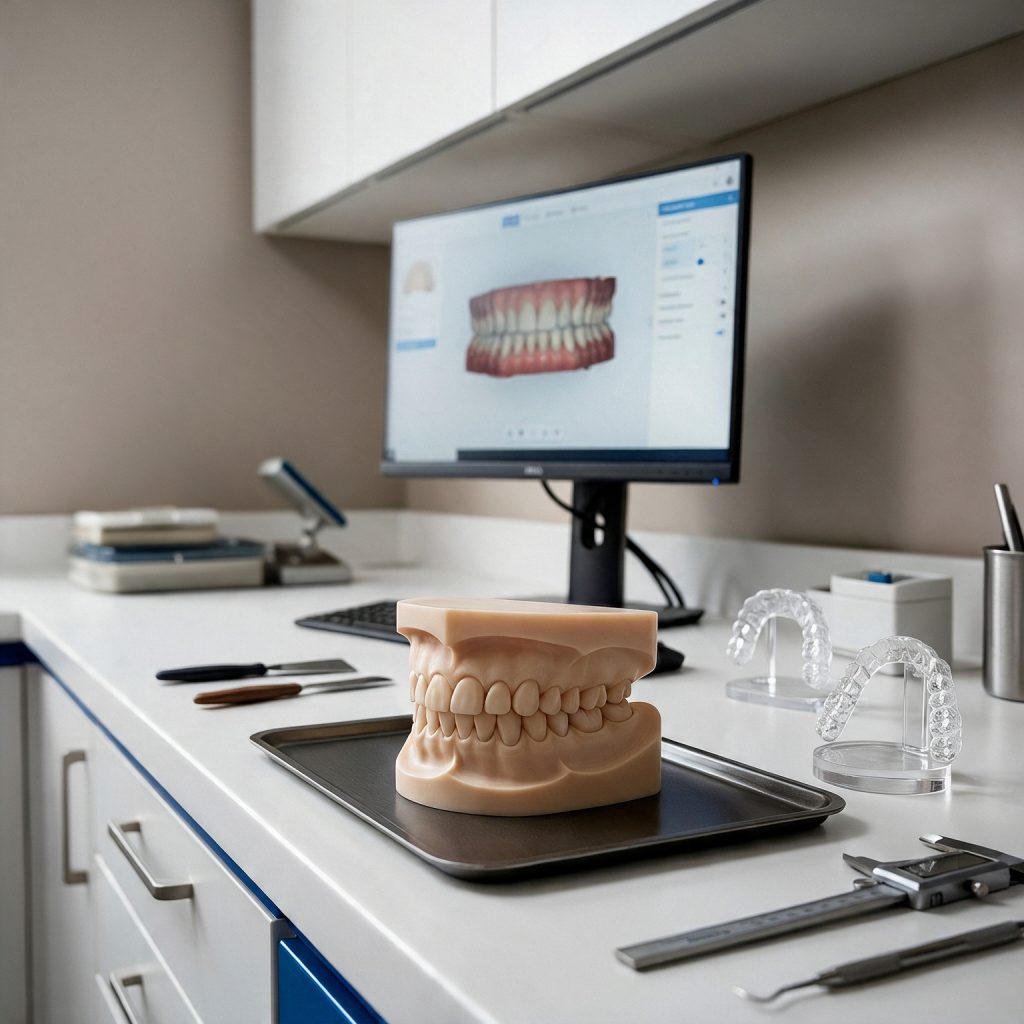
A modern orthodontic production workflow is often described simply:
Scan → Plan → Print → Form → Trim → Finish → Deliver
But every arrow in that sequence represents a dependency.
The quality of the printed model affects the forming stage.
The forming stage affects trimming.
Trimming affects finishing.
And every downstream step inherits some of the decisions made earlier in the process.
This is why model production should not be treated as an isolated printing task.
The 3D printed model is a manufacturing component.
Its job is not simply to represent digital design. Its job is to provide a reliable physical foundation for what comes next.
What We Look At, at Taglus
At Taglus, we look at orthodontic materials as part of a connected workflow rather than as individual products.
That same thinking applies to 3D printed models.
When a model is being produced for thermoforming, we care about more than whether the printer completed the job.
We care about:
- Dimensional consistency
- Anatomical detail
- Surface uniformity
- Post-processing consistency
- Compatibility with the next manufacturing step
Because the model is not the final product.
It is the foundation on which the next product is made.
The Bigger Point
Surface finish is easy to overlook because it rarely appears as a headline specification.
It is not as visible as printer resolution or as obvious as the final aligner sitting in a case.
But manufacturing quality is often determined by details that are easy to overlook.
A rough surface does not necessarily mean a failed model.
A smooth surface does not necessarily mean a perfect one.
What matters is consistency: a model surface that accurately represents the digital design and provides a predictable foundation for the thermoforming process.
For dental labs moving toward higher-volume digital production, that distinction becomes increasingly important.
Because when every model feeds the next stage of production, small variations at the beginning can become larger variations by the end.
The question, then, is not simply: “Did the model print?”
It is: “Is the model ready for what comes next?”
At Taglus, that is the standard we believe a digital orthodontic workflow should be built around.
Have Questions?
 Talk to us on WhatsApp
Know More About Us
SignUp To Our Newsletter And Get To Know More About Taglus

Taglus is the global industry leader in the manufacturing of innovative clear Aligner and retainer thermoplastic sheets.

Copyrights@taglus-2026
*Taglus is a trademark of Vedia Solutions
Leave a Reply