


Enquire Form
Layer Adhesion in Multilayer Sheets: Why It Matters for Aligner Performance
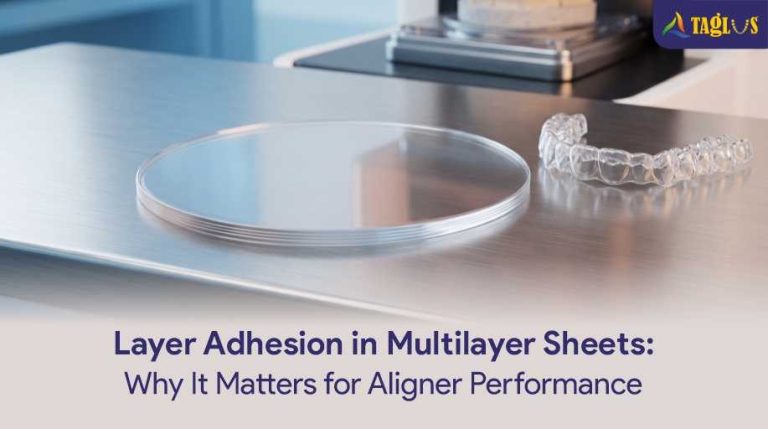
Multilayer aligner sheets are easy to describe. Two or more polymer layers are combined to form into a single sheet, each layer contributes a property, and the result is a material that does more than a single layer can. On a data sheet, it looks like an upgrade. But anyone who has worked with these materials knows that they are only a part of the whole story. What holds them together matters just as much.
That is where layer adhesion comes in.
A Multilayer Sheet Is meant to behave as One Material
In a normal multilayer design, different layers are chosen for different roles. An outer layer may contribute to stiffness and stain resistance, while an inner layer contributes to flexibility and stress relaxation. Together, they are intended to support consistent force delivery while keeping the aligner durable.
The important word there is together.
Layer adhesion is the strength of the bond between those layers. When it is strong, it will flex, stretch, and recover back to a single structure. When it is weak, the sheet starts to behave less like one engineered material and more like separate films stacked on top of each other.
This difference is easy to overlook on a spec sheet, but it becomes more visible in thermoforming and in the patient’s mouth.
It Matters before the Aligner Is even formed
Adhesion is often discussed as a wear-related property, but its first real test happens on the thermoforming machine. During thermoforming, the sheet is heated and stretched over the dental model. That stretch is not uniform. Areas with deeper geometry or greater curvature experience far more displacement than flatter surfaces, and every layer of the sheet must move with that deformation.
If the bond strength is inadequate, the consequences manifest early: layers shift relative to each other, wrinkle, or separate under stress. So, when a sheet is described as multilayer, the question is not only what each layer does, but also if it stays unified through forming.
What Happens When Layers Stop Working Together
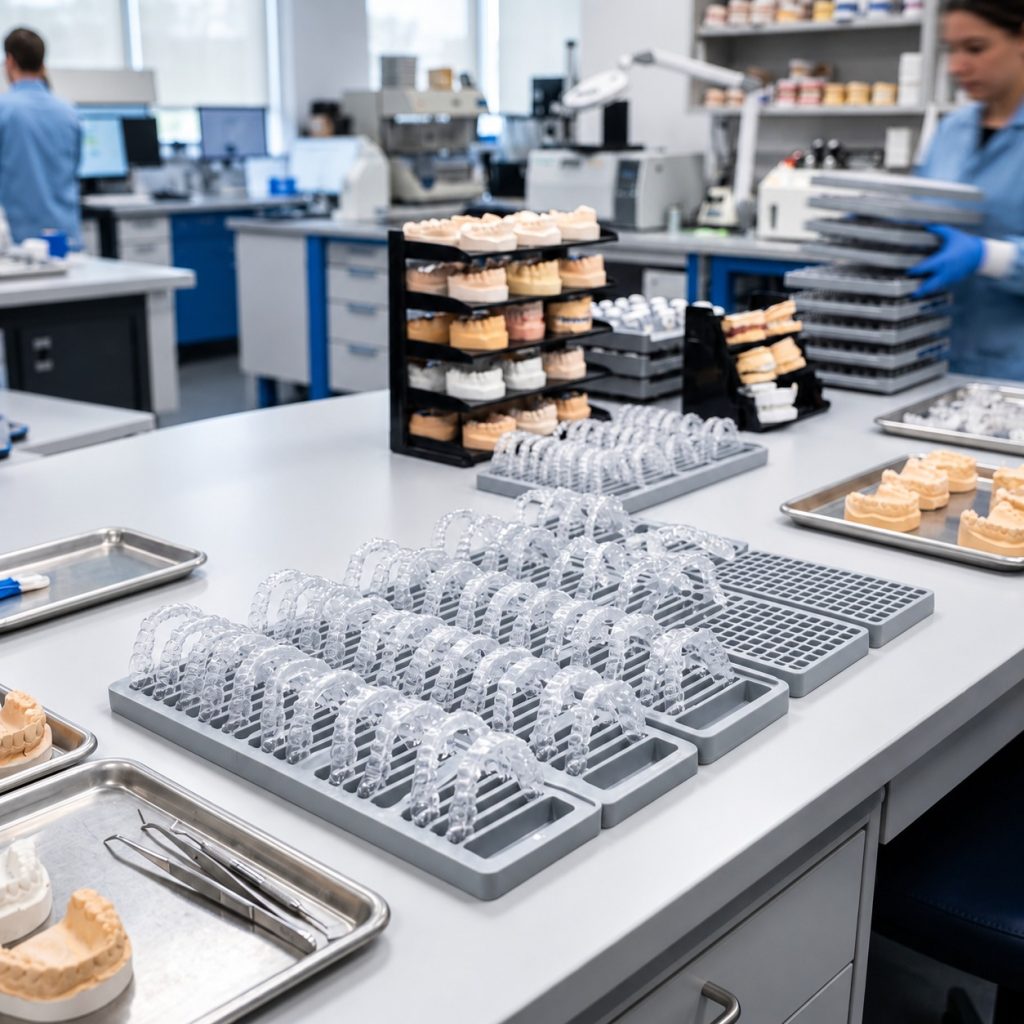
The most visible sign of poor adhesion is delamination, where layers begin to separate. It often starts small: a hazy patch, tiny bubbles, or an edge that begins to lift. Left alone, it can progress to visible splitting.
But the effects of weak adhesion are not just visual. It also affects:
Force delivery: For a predictable aligner performance, an appliance should provide consistent force throughout its wear period and across the treatment area. Delamination disrupts the uniformity of the material.
Durability: An aligner is exposed to challenging conditions in a patient’s mouth for an extended period of time. The material should resist environmental degradation and mechanical stress without delamination.
Clarity: Patients choose clear aligners partly because they are discreet. Separation between layers scatters light, which show up as haze or white patches.
Hygiene: Gaps between separated layers can trap moisture and debris, making the appliance harder to keep clean.
None of these issues are dramatic on its own. But they all trace back to the same starting point: the layers stopped acting as one.
Adhesion Is Built In, not added later
It is tempting to think of layer adhesion as a simple pass-or-fail quality. In practice, it is the outcome of several factors working together.
Polymer compatibility matters, since layers need to bond at the molecular level, sometimes with the help of a tie layer. The manufacturing process matters too, because factors like temperature, pressure, and cooling during co-extrusion directly influence bond quality. Surface condition between layers plays a role. And consistency matters, since adhesion needs to be uniform across the sheet and from batch to batch, not just in a single test sample.
This is one reason why two sheets with similar layer structures on paper can behave differently in practice.
The Process Can Stress a Good Bond
Layer adhesion does not exist in isolation. How the sheet is handled also matters
Heating that is uneven or excessive, aggressive stretching, or improper storage can all put additional stress on a multilayer structure. A well-bonded sheet gives a laboratory more margin, but it does not remove the need for good process control.
Thermoforming parameters, material handling, and machine performance matter too. A high-quality sheet cannot overcome improper forming conditions; similarly, a sophisticated machine cannot compensate for a material that is not suited to the process.
Why It Becomes More Important when Production Scales
For a laboratory producing a handful of aligners, an occasional issue is relatively easy to spot and correct. At higher volumes, the same variation can be much harder to catch.
If adhesion is inconsistent from one batch to the next, or from one area of the sheet to another, those differences quietly multiply across hundreds or thousands of aligners. This is where consistency stops being a nice-to-have and becomes a requirement for a scalable workflow.
What Should Labs Look for in a Multilayer Sheet?
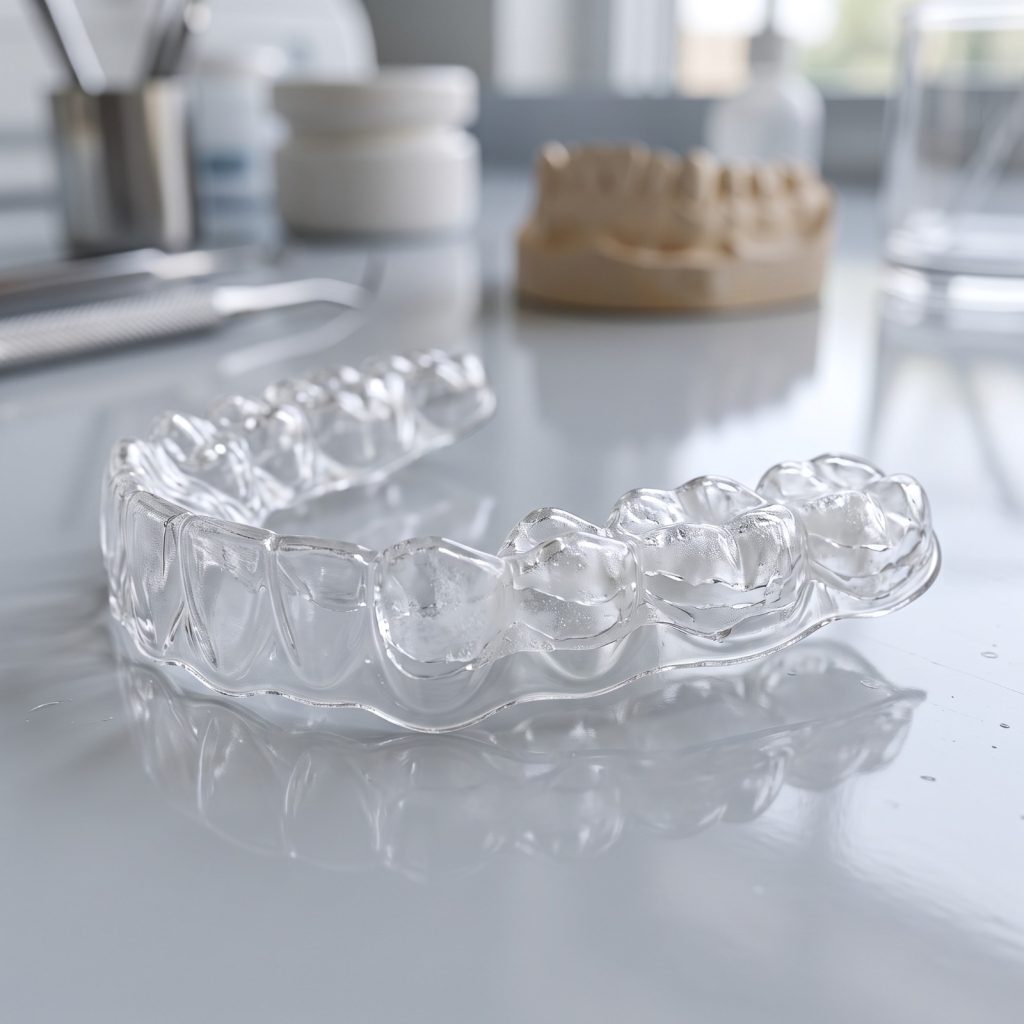
A single number that defines the interlayer adhesion of a multilayer sheet does not exist, but there are several important considerations:
Testing: What evidence supports these adhesion claims? Peel strength and delamination resistance are meaningful indicators, especially after aging or thermal cycling.
Batch consistency: Is quality reliable from one production batch to the next?
Forming characteristics: How does the material behave during thermoforming? Does it exhibit delamination, wrinkling, or other defects?
Long-term performance: What is the expected lifetime of an appliance made from this material? Can it resist environmental conditions and prolong mechanical stress?
Transparency: Is the supplier clear about the material’s structure and specifications?
These questions become especially relevant when laboratories move toward more standardized, higher-volume manufacturing.
Materials Do Not Work Alone
It is easy to evaluate a sheet as a standalone product. In reality, its performance is shaped by everything around it: heating, forming, cooling, trimming, and the digital workflow that produced the model in the first place.
The strength of a multilayer sheet is that it combines the advantages of different materials in one structure. Layer adhesion is what allows that promise to hold up, from the thermoforming machine to the end of the wear cycle.
Layer Adhesion and the Bigger Picture at Taglus
At Taglus, we look at materials as part of a complete aligner manufacturing workflow rather than as isolated components. Thermoforming sheets, dental materials, equipment, 3D printing solutions, and trimming systems all play a role in maintaining consistency from one stage to the next.
Because a multilayer sheet is only as reliable as the way its layers are bonded, formed, and finished. And ultimately, that is what turns a well-designed material into a well-performing aligner.
Want to learn more about Taglus materials and thermoforming solutions? Get in touch with our team to explore how a connected workflow can support your production.
Have Questions?
 Talk to us on WhatsApp

Know More About Us
SignUp To Our Newsletter And Get To Know More About Taglus

Taglus is the global industry leader in the manufacturing of innovative clear Aligner and retainer thermoplastic sheets.

Copyrights@taglus-2026
*Taglus is a trademark of Vedia Solutions
Leave a Reply