


Enquire Form
Color Stability vs. Optical Clarity: What’s the Difference, and Why Should Labs Care?
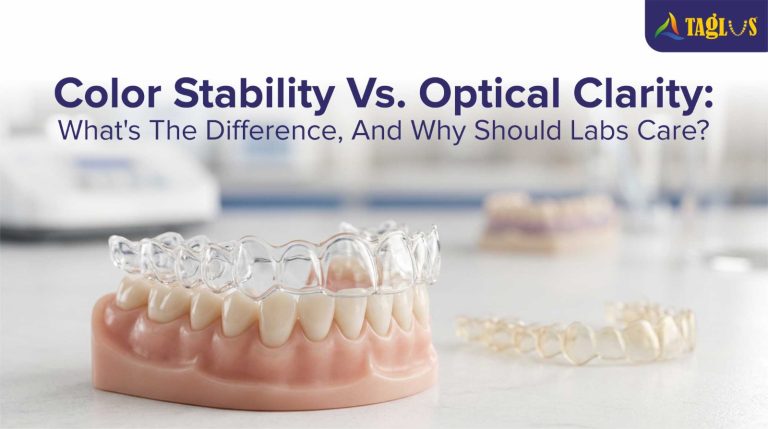
Optical clarity and color stability are often used interchangeably when discussing clear aligners. But they are not the same property. One defines the appliance’s initial visual appearance. While the other determines how well the appearance is maintained over time. Together, they influence your ability to deliver a premium experience.
Understanding the difference is important when checking the material quality. A sheet can perform well in one property without necessarily well in the other.
Optical clarity: The Initial Visual Standard
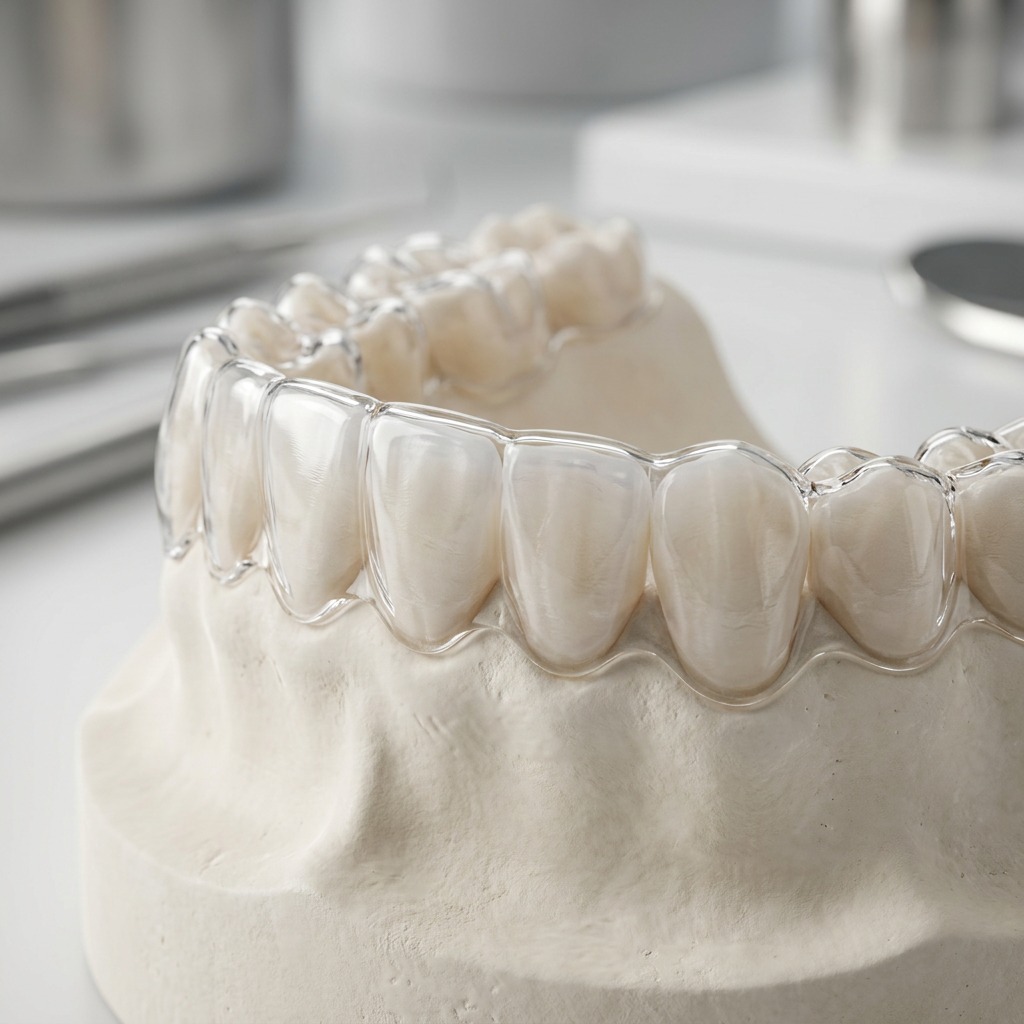
Optical performance is not a single number. It includes light transmission and haze, with surface and internal scattering influencing how clear an appliance appears. In simple terms, it determines whether an aligner looks discreet over the dentition or appears cloudy or dull.
When optical clarity is high, the appliance blends naturally with the patient’s smile. The teeth remain visible, edges look refined, and the aligner supports the aesthetic promise. This drives the demand for clear aligners.
Color Stability: The Long-term Visual Standard
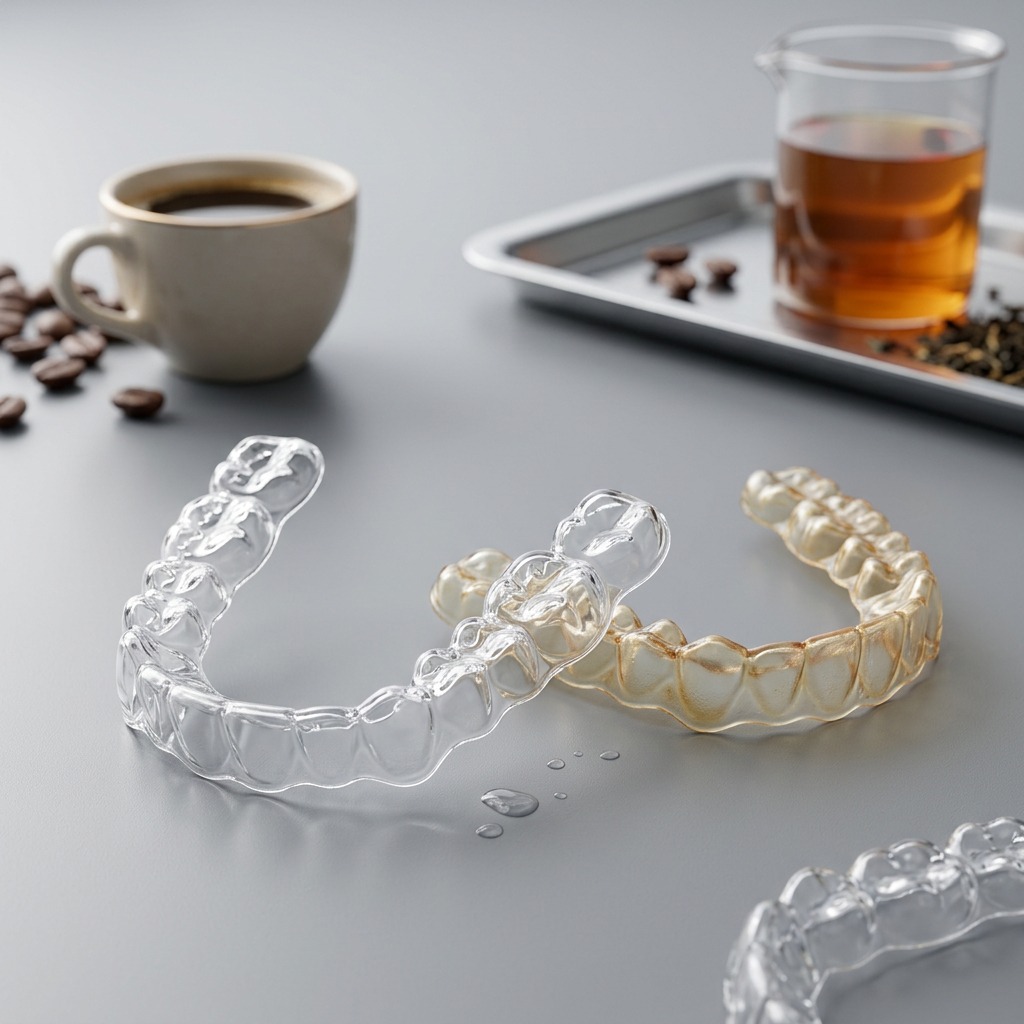
Color stability can be evaluated by measuring changes in color coordinates, such as CIELAB values, after defined exposure conditions. Clear aligners are exposed to saliva, temperature variation, food pigments, oral hygiene products, and daily handling. Coffee, tea, cola, red wine, smoking and highly pigmented foods can influence the appearance of the appliance.
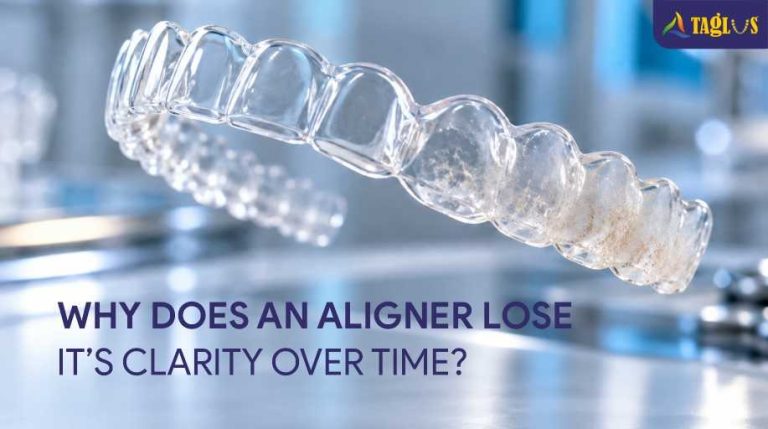
This matters because an appliance can look exceptionally clear initially. Yet develop visible discoloration. Research on commercial aligner materials shows that staining behavior is material-dependent and can be influenced by the interaction between the polymer, staining agents, and surface characteristics. Coffee and red wine, for example, have been shown to produce perceptible color changes in tested aligner materials.
Initial transparency is not enough. The material should be selected with sustained visual performance in mind.
| OPTICAL CLARITY | COLOR STABILITY |
| The clarity and transparency of the appliance at delivery. | How well the appliance resists yellowing and staining over time. |
| Influenced by material structure, sheet quality, thermoforming, surface finish, and handling. | Influenced by material chemistry, surface condition, staining agents, moisture interaction, and wear conditions. |
| The first visual impression is affected. | Affects the sustained aesthetic performance. |
| Evaluated using luminous transmittance and haze measurements. | Measured through changes in color values over time. |
An aligner can have excellent initial optical clarity but poor color stability. Conversely, a material can resist staining while still exhibiting haze or surface-related optical defects.
Why Labs Need to Control Both
In today’s global aligner market, labs are not competing only on turnaround time. They are competing on consistency. Clinicians expect appliances that fit accurately, predictably, look premium, and arrive ready for delivery.
When optical clarity is compromised, labs can face:
- More quality queries
- Low confidence in the finished appliance
- Higher remake and replacement rates
- Inconsistent output across technicians, machines, or production locations
- Low value in a competitive market
- A disconnect between the quality promised and the quality delivered.
A high performing lab does not treat clarity as an optional aesthetic advantage. It builds clarity into its production standards.
The right sheet must balance optical quality with processing behavior, strength, flexibility, force delivery, crack resistance, and the clinical purpose of the appliance. The right material for a high throughput workflow may require different processing controls.
Qualities Influencing Color Stability
The result of the appliance is shaped by every touchpoint in the workflow.
Sheet handling
Dust, moisture, fingerprints, scratches, and improper storage can affect the surface quality. A visually clean appliance begins with a protected sheet surface.
Thermoforming discipline
Uneven heating, excessive heat exposure, poor cooling control, or incorrect forming parameters can compromise the final product. Haze, thinning, distortion, and reduced visual uniformity can all affect the appliance.
Different polymer systems and sheet formulations have different thermoforming windows. Heating profile, forming temperature, dwell time, cooling behavior and machine parameters should be validated for the specific sheet and thermoforming system.
Model preparation
Residual resin, inadequate post-curing, moisture, rough model surfaces or contamination can compromise the fit and surface finish of the thermoformed appliance.
Trimming and finishing
A premium sheet can lose its visual advantage during the final stages of production. Rough edges, aggressive trimming, surface abrasion, or inconsistent polishing can introduce visible defects. This reduces the perception of quality.
Thickness
It influences the optical path through the material while also affecting the mechanical behavior of the finished appliance. For labs, this means optical performance should always be considered alongside the thickness and intended application of the sheet.
What This Means for Material Selection
At Taglus, material innovation is designed around the requirements of modern aligner manufacturing. The portfolio gives labs the flexibility to select materials based on appliance type and objective.
Taglus Premium is a PETG-based material positioned around optical clarity, stain resistance, rigidity, elasticity and crack resistance. Taglus currently reports 91% light transmission under ASTM D1003.
Taglus PU Flex is a homogeneous polyurethane sheet engineered around flexibility, strength, durability and toughness, offering labs a different performance profile from conventional rigid aligner materials
Taglus Standard is a copolyester material positioned around transparency, chemical resistance, processability and versatility across aligners, retainers and surgical splints, with Taglus reporting 90% light transmission.
For retainer-focused applications, Taglus Tuff is built around clarity, rigidity, elasticity and thin 0.8 mm construction.
Across Taglus thermoforming sheets, double-side masking helps protect the material surface during storage, handling, thermoforming and finishing. The protective layers should remain in place through production and be removed only at the final stage. This helps labs preserve the optical quality that clinicians expect to see.
Have Questions?
 Talk to us on WhatsApp

Know More About Us
SignUp To Our Newsletter And Get To Know More About Taglus

Taglus is the global industry leader in the manufacturing of innovative clear Aligner and retainer thermoplastic sheets.

Copyrights@taglus-2026
*Taglus is a trademark of Vedia Solutions
Leave a Reply