


Enquire Form
Thermoforming Dental Sheets: A Beginner’s Guide for New Labs
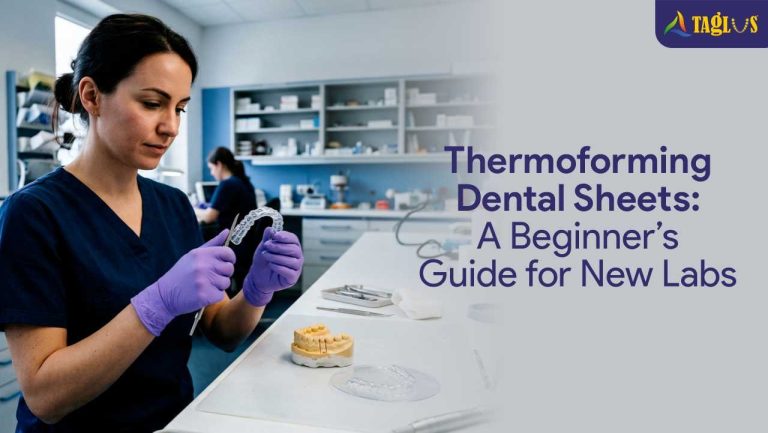
Starting a dental lab today means working with more than just traditional tools and materials. With digital dentistry becoming a regular part of dental development, many new labs are exploring workflows for clear aligners, retainers, night guards, and other orthodontic appliances.
In all these appliances, one material you will see is the thermoforming dental sheet.
When the lab is new, knowing more about the thermoforming sheets and how its properties affect its behaviors can significantly affect your decisions.
Terms such as thickness, flexibility, clarity, heating temperature, forming pressure, and material type can quickly become overwhelming. This guide breaks down the basics of thermoforming dental sheets and explains what new dental labs should know before adding them to their workflow.
What Are Thermoforming Dental Sheets?
Thermoforming dental sheets are specially manufactured polymer sheets that become soft and moldable when heated. Once heated to the appropriate temperature range, the sheet can be thermoformed over a dental model to create a customized appliance.
After cooling, the material retains the shape of the model.
This basic process is used in the fabrication of several dental and orthodontic appliances, including:
- Clear aligners
- Retainers
- Night guards
- Whitening trays
- Other custom thermoformed dental appliances
While the material may look like a simple plastic sheet, its performance depends on several factors, including its composition, thickness, optical properties, flexibility, and ability to maintain its shape after forming.
How Does the Thermoforming Process Work?
A dental model is prepared, most commonly using a digital workflow that includes scanning and 3D printing. The dental model is then inspected for any obvious deformity.
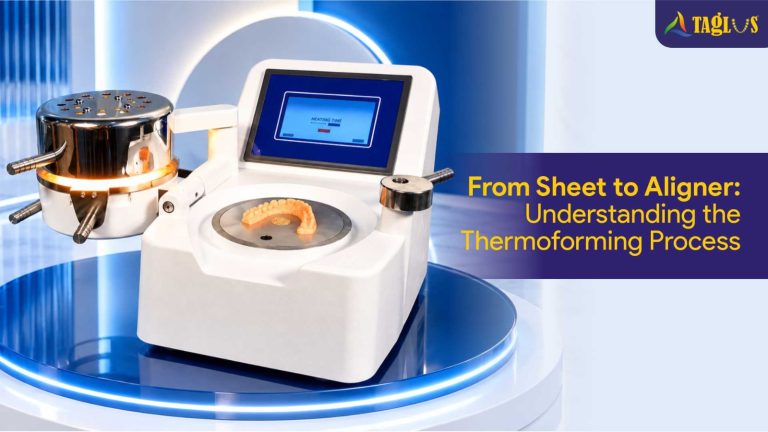
The thermoforming sheet is then placed into a thermoforming machine and heated. As the material reaches the required thermoforming temperature range, it becomes soft. The heated sheet is then thermoformed over the dental model, using pressure or vacuum. This makes the sheet take up the shape of the model.
This process depends on the type of thermoforming equipment being used.
Once the sheet cools, it retains the shape of the model. The formed appliance can then be removed, trimmed, finished, and prepared for the next stage.
In a typical digital orthodontic workflow, this can look like:
Scan → Plan → Print → Form → Trim → Finish → Deliver
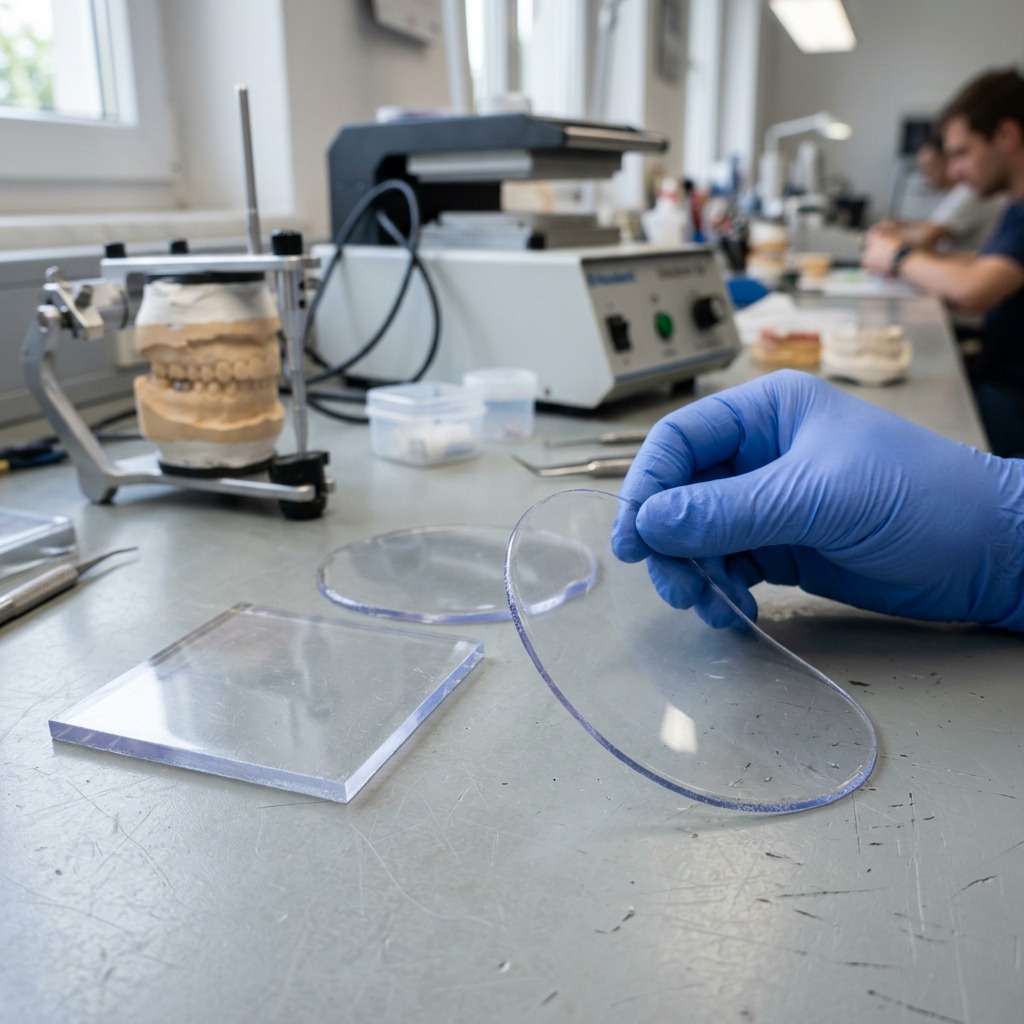
For a new lab, understanding all the steps is critical because the final result does not depend only on the sheet. It is the model, machine, heating process, forming conditions, and finishing process all working together.
Why Does Sheet Selection Matter?
Not every sheet is ideal for every appliance. A sheet that works well for one appliance may not be the right choice for another.
For example, an aligner has a different requirement for flexibility, strength, clarity, and elastic recovery than a retainer or a night guard.
Therefore, when selecting a thermoforming sheet, the intended application should be the lab’s primary concern.
Some fundamental characteristics to look at:
1. Thickness
Sheet thickness can greatly impact flexibility, strength, and final performance of the appliance.
A thinner sheet may provide greater flexibility, while a thicker sheet may be selected when additional rigidity or increased amount of force is required.
The appropriate thickness will ultimately depend on the appliance being made and the manufacturer’s recommendations.
2. Clarity
For clear aligners and retainers, appearance is a significant consideration. Good optical clarity ensures that the appliance maintains a clean and discreet appearance when worn.
However, clarity should not be considered in isolation from other material properties. A dental sheet intended for aligners needs to provide a good balance between appearance and functional performance.
3. Flexibility
Flexibility determines how easily the formed appliance can adapt to the desired shape and how it behaves during use.
For orthodontic applications, controlled flexibility helps ensure that the appliance delivers the optimum amount of force without adding unwanted stresses to the teeth and trauma to the surrounding tissues.
4. Elastic Recovery
A thermoformed appliance needs to maintain its intended shape and provide consistent performance during use.
Elastic recovery refers to a material’s ability to return toward its original shape after being deformed. This property can be particularly relevant when evaluating materials for orthodontic applications.
5. Thickness Uniformity
Uniform sheet thickness is another essential consideration for dental labs.
If the thickness varies significantly across a sheet, the material may not behave normally during forming. It will not heat uniformly and will not form over the model properly.
Uniformity helps support more predictable thermoforming and standardised appliance manufacturing.
6. Layer Adhesion
Some dental sheets are made using multiple layers to combine diverse material properties. In such materials, the layers need to remain firmly bonded together during forming and use.
Good layer adhesion helps maintain the integrity of the sheet rather than allowing individual layers to separate.
What Should New Labs Look for in a Thermoforming Sheet?
When you are setting up a new lab, it can be tempting to focus only on price. While cost is certainly of essence in purchasing decisions, it should not be the only consideration.
Instead, look at the entire workflow.
Ask questions such as:
- What application is the material intended for?
- What thickness options are available?
- Is the material easy to thermoform?
- Does it provide consistent results?
- What thermoforming equipment is recommended?
- Does the manufacturer provide forming guidelines?
- How does the material perform after forming?
- Is the sheet suitable for the production volume of your lab?
- Is technical support available when you need it?
The right material should fit your workflow rather than forcing your workflow to adapt to the material.
Understanding Heating Is Important
One of the most common mistakes new labs can make is treating heating as a simple step.
It is not simply about putting a sheet into a machine and waiting for it to become soft.
The sheet needs to reach the appropriate temperature. Underheated, it may remain stiff and not form properly around the model. If it is overheated, the material may behave unexpectedly.
Different materials can have distinct processing requirements, so it is crucial to follow the manufacturer’s recommended parameters.
The thermoforming machine also plays a role. Heating consistency, pressure, vacuum, and cycle time can all influence the result.
This is why new labs should spend time understanding their equipment and material together.
The Role of the Dental Model
The thermoforming sheet is only one part of the process.
Since the appliance is made when it is thermoformed over a model, the quality of the dental model can also affect the final appliance.
With digital dentistry, many labs now use 3D-printed models. A well-designed and accurately printed model can provide a reliable foundation for thermoforming.
Before thermoforming, ensure that the model:
- Matches the intended digital design
- Has sufficient dimensional accuracy
- Is properly finished
- Does not contain defects
- Is ideal for the thermoforming process
A small mistake or imperfection in the model can become more noticeable after the sheet is thermoformed over it.
Common Mistakes New Labs Should Avoid
Choosing a Material only because It Is Cheaper
A lower material cost does not always mean a lower overall fabrication cost.
If a material produces inconsistent results, takes up more time to trim and polish, or creates more remakes, the apparent saving can disappear quickly.
Ignoring Manufacturer Guidelines
Every material has specific processing recommendations. Temperature, heating time, forming conditions, and other parameters should be followed carefully, especially when a lab is working with a new material for the first time.
Using the Same Sheet for Every Application
Instead of treating thermoforming sheets as a one-size-fits-all material, understanding which sheet is designed for what kind of appliances is of vital importance.
Skipping Quality Checks
A quick inspection of the appliance after thermoforming can help identify problems early. A problem caught before the appliance moves to the next stage is time saved.
Check the fit, surface quality, thickness consistency, shape, and overall appearance before trimming and finishing.
How Can a New Lab Improve Consistency?
Consistency becomes paramount as production volume increases.
A lab producing a few appliances is able to manage variation manually. But as cases increase, inconsistent processes can lead to more adjustments, remakes, and wasted material.
New labs can ensure consistency by:
Standardising the workflow:
Keep the case-to-case process as standardised as possible.
Follow recommended parameters:
Use the manufacturer’s guidelines as the starting point..
Training operators:
Make sure everyone handling the thermoforming process understands the equipment and material. Trained operators will drastically improve product handling.
Monitoring quality:
Regularly inspect formed appliances and flag recurring issues.
Choosing reliable materials:
Sourcing consistent raw materials will support reliable fabrication.
Thermoforming Is More Than Just Heating a Sheet
For someone new to dental manufacturing, thermoforming appears simple. You heat a sheet, form it over a model, and trim the finished appliance.
In practice, there is a lot more involved. The material, model, machine, heating conditions, forming processes, and finishing all contribute to the result.
Understanding this ensures that new labs build an appropriate workflow that is easier to control and scalable as the lab grows. Having a clear and repeatable thermoforming process can ensure fewer adjustments and improve production efficiency.
Thermoforming dental sheets are a crucial part of modern orthodontic and dental manufacturing methods. New labs should understand the basics of material selection and its processing before they make the transition into thermoforming.
Start by identifying the appliances you want to produce, understand the material properties that matter for those appliances, and follow the manufacturer’s processing recommendations.
Most importantly, do not look at the sheet as an isolated product.
A successful thermoforming workflow is the result of the right material, the right model, the right equipment, and a controlled process working together.
Once you understand this, thermoforming becomes a much simpler and manageable part of your digital dental workflow and a strong foundation for dependable production as your lab grows.
Have Questions?
 Talk to us on WhatsApp

Know More About Us
SignUp To Our Newsletter And Get To Know More About Taglus

Taglus is the global industry leader in the manufacturing of innovative clear Aligner and retainer thermoplastic sheets.

Copyrights@taglus-2026
*Taglus is a trademark of Vedia Solutions
Leave a Reply