


Enquire Form
Why Aligner Sheet Thickness Alone Doesn’t Determine Force Delivery
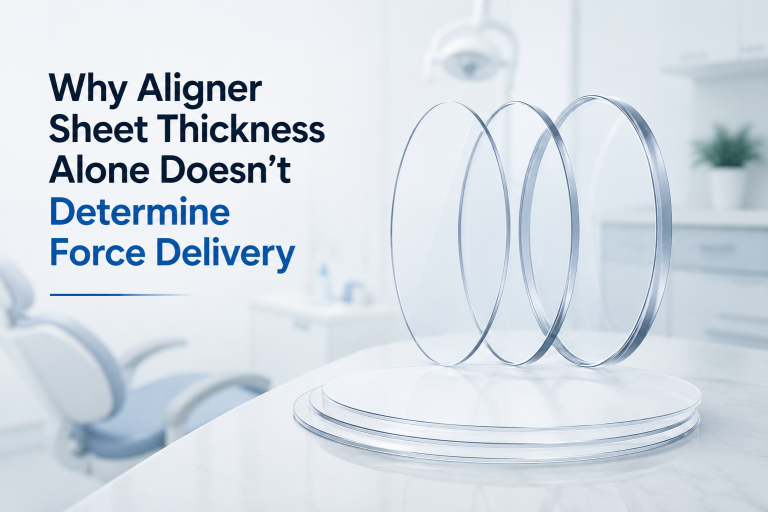
Aligner sheet thickness comes up constantly in conversations between dentists and lab technicians, and understandably so. It feels like one of those variables that should have a predictable relationship with the outcome. Thicker sheet, more force. Thinner sheet, gentler force. Except it does not quite work that way in practice, or at least not as neatly as the marketing materials sometimes suggest.
This is worth unpacking a bit, because a lot of clinicians, understandably, treat sheet thickness as the main lever for force delivery when really it is just one variable among several that interact in ways that are not always obvious until you have seen enough cases go slightly off script.
What Aligner Sheet Thickness Actually Refers To
Before going further, it is probably worth clarifying what we mean here, since the term gets used loosely sometimes. Aligner sheet thickness typically refers to the gauge of the thermoplastic material before it is thermoformed over the model, usually measured in millimeters, often somewhere in the range of 0.5 mm to 1 mm depending on the manufacturer and the type of material.
Thicker sheets are generally assumed to deliver higher forces because there is simply more material resisting deformation. That much is broadly true in a mechanical sense. But the assumption that thickness translates directly into predictable clinical force is where things get a little more complicated.
Why Thickness Is Only Part of the Picture
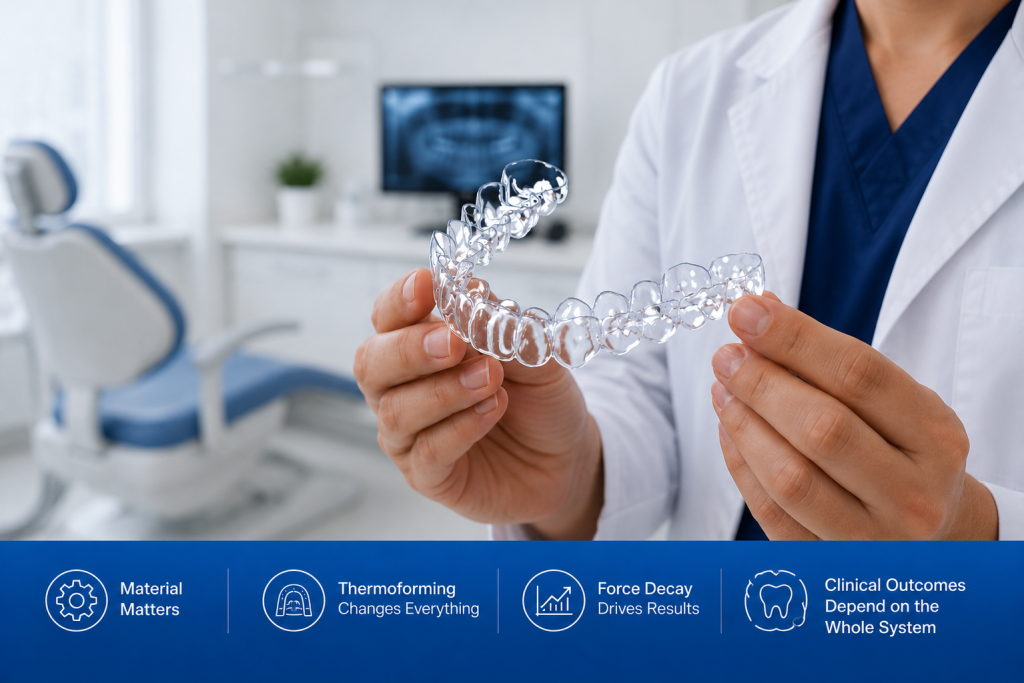
Once a flat sheet of plastic is thermoformed over a dental model, its properties change. Depending on the quality of the material, it stretches unevenly across different tooth surfaces, particularly around areas with more pronounced curvature, like canines or rotated teeth. So the final thickness at any given point on the aligner is not actually the same as the original sheet thickness. It might be thinner over convex surfaces and comparatively thicker in flatter regions.
This means two aligners made from the same nominal sheet thickness can behave quite differently depending on tooth anatomy, the thermoforming technique used, and even how long the material was heated before thermoforming. It is not something that shows up easily on a spec sheet, but it does show up clinically, sometimes as tracking issues that seem to have no obvious cause.
There is also the question of material composition itself. Not all plastics of the same thickness behave identically. Polyurethane-based materials, PETG-based sheets, and multilayered materials each have different flexural properties, different memory characteristics, and different rates of force decay over the wear period. So, a 0.6 mm sheet of one material type is not necessarily equivalent to a 0.6 mm sheet of another type of material. This distinction seems to be something that gets glossed over quite often in general discussion, perhaps because it complicates an otherwise simple story.
Force Decay and Why It Matters More Than Peak Force
Something that tends to get underappreciated is that initial force is not really the clinically meaningful figure. What matters more is how that force decays over the wearing period, typically one to two weeks per aligner stage. A thicker sheet might deliver a higher initial force, but if it also decays faster due to material fatigue or stress relaxation, the net effect on tooth movement could end up fairly similar to a thinner sheet that holds its force more consistently.
This is probably one of the more counterintuitive points to communicate to patients, and even to newer clinicians. More force does not automatically mean faster or more efficient movement. In fact, excessive initial force delivered too quickly is often associated with root resorption risk and patient discomfort, without necessarily improving the rate of controlled tooth movement.
What This Means for Case Planning
For dentists planning aligner cases or reviewing treatment plans generated by aligner labs, it might be worth asking a few more questions than usual rather than assuming sheet thickness alone tells the full story. Questions such as which material is being used, whether it is a single layer or multilayered material, and how will you manage the uneven thinning during thermoforming, seem like reasonable things to think about, particularly for cases involving more complex movements like rotations or intrusions.
It also seems sensible to consider staging strategies alongside material selection rather than in isolation. For example, complex rotations might benefit less from simply increasing sheet thickness and more from smaller movement increments per stage, additional attachments, or a combination of both. Thickness on its own is rarely the single answer to a stubborn tracking issue.
Talking Patients Through This Without Overcomplicating Things
Patients generally do not need to understand the material science behind their aligners, and it would probably be unhelpful, or at least unnecessary, to go into detail about thermoforming behaviour during a consultation. What tends to matter more to them is understanding, in simple terms, why some stages might feel different to others, why comfort levels vary, and why persistence with wear time still matters even if a particular tray feels a bit tighter or more relaxed than expected.
It might help to explain that aligner material is engineered to apply gentle, sustained pressure over time and that some variation between stages is normal and there is nothing to worry about, provided tracking is being monitored at review appointments.
A Few Things Worth Remembering
Sheet thickness is a genuinely useful variable to understand, but it should probably be seen as one input into a broader system rather than a standalone predictor of force or outcome. Clinical experience, appropriate monitoring, and open communication with the aligner lab likely matter just as much, if not more, particularly for cases that are not straightforward.
There does not seem to be a universally agreed formula linking thickness directly to force delivery across all systems, and that is probably fine. Dental materials rarely behave with complete predictability once they interact with individual patient anatomy, wear patterns, and compliance. Being aware of that complexity, rather than looking for a single simple rule, is probably the more useful mindset for clinicians navigating aligner treatment planning day to day.
If nothing else, it is worth remembering that thickness matters, but not in isolation, and that questioning assumptions occasionally, rather than taking manufacturer specifications entirely at face value, tends to serve both the clinician and the patient rather well over the course of treatment.
At Taglus, we know predictable aligner performance depends on far more than sheet thickness alone. That’s why our materials are engineered for consistent force delivery, precise thermoforming, and dependable mechanical properties, helping clinicians achieve more predictable outcomes across a wider range of cases. To know more, get in touch with our team today.
Have Questions?
 Talk to us on WhatsApp

Know More About Us
SignUp To Our Newsletter And Get To Know More About Taglus

Taglus is the global industry leader in the manufacturing of innovative clear Aligner and retainer thermoplastic sheets.

Copyrights@taglus-2026
*Taglus is a trademark of Vedia Solutions
Leave a Reply