


Enquire Form
What Research On Retainer Sheet Deformation Tells Labs
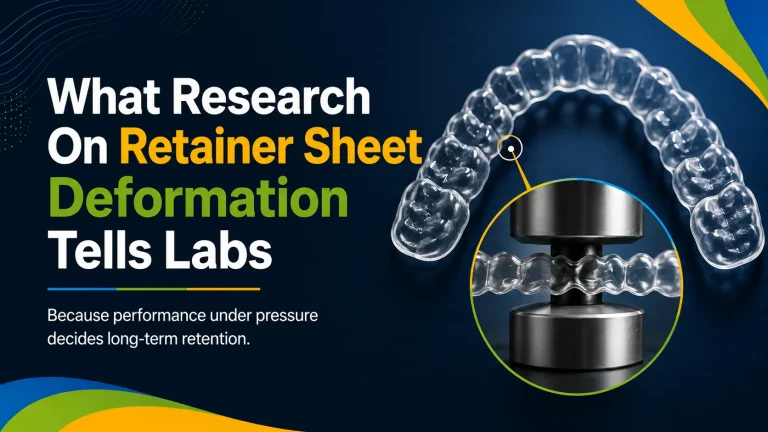
If you have ever held two retainer sheets from different brands side by side, you have probably noticed they look almost identical. Same clarity, similar thickness, comparable feel between your fingers. But what published research on retainer sheet deformation tells labs, repeatedly, is that appearances can be deceiving. Two sheets that seem mechanically interchangeable can behave in quite different ways once they are under real compressive load in a patient’s mouth, and that difference often decides whether a retainer holds tooth position for months or starts losing its grip within weeks.
Why Retainer Sheet Deformation Tells Labs Something Brand Names Don’t

Labs are under constant pressure to choose materials quickly, often based on price per sheet, supplier relationships, or simply what has been used for years out of habit. None of that is unreasonable. But it does mean the actual mechanical behavior of a sheet. How it responds when compressed, stretched, or held under sustained load, sometimes gets less attention than it probably deserves.
This is where the distinction between elastic deformation and rigid, or plastic, displacement becomes genuinely useful. Elastic deformation is temporary. The material bends or flexes under force and then largely returns to its original shape once the load is removed. Plastic deformation is different. Once a material is pushed past a certain threshold, it doesn’t fully spring back, and in a retainer this kind of permanent change can translate fairly directly into loss of fit and, over time, relapse.
One comparative study evaluated mechanical properties across direct 3D printed retainer materials and a thermoformed material and found a statistically significant difference in Young’s modulus between groups, which is essentially a measure of how stiff and how elastic a material behaves before it starts to deform permanently. ¹ Stiffness alone doesn’t tell the whole story though, because a material that’s stiffer isn’t automatically the better choice for every patient or every application.
Thickness seems to matter quite a lot too, and it’s worth flagging because it’s easy to assume thickness is mainly a comfort or aesthetic decision. A 2022 study on 3D printed fixed retainers, using samples of varying thickness aged in an artificial saliva bath, found that the thickest samples (1.2 mm) showed the highest flexural modulus, deflection, creep and overall strength, while the thinnest samples had the lowest modulus of elasticity. However, it was highlighted that bending strength of 0.8 mm (about 0.03 in) thick samples was several times higher than that of 1 mm (about 0.04 in) thick samples. ²
Stress relaxation is another piece of the puzzle that doesn’t get talked about enough. A 2024 study tracked retention force in Hawley and vacuum-formed retainers over six months and found something telling: most of the loss happened in the first three months, not spread evenly across the year. ³ Hawleys lost more than half their grip by six months; VFRs held up better but still slipped noticeably. That front-loaded pattern is worth paying attention to; it suggests the first few months matter more for monitoring and follow-up than people might assume, rather than retention fading slowly and evenly the whole way through. It’s the kind of nuance that no price tag or brand name will tell you.
More recent work has also looked at how temperature and the wet intraoral environment affect these properties, which feels relevant given how much retainers are exposed to varying oral conditions. A 2024 study comparing thermoplastic and 3D-printed retainer materials found that water immersion alone was enough to reduce tensile strength, elastic modulus, and hardness across the board, with the effect later reversing after longer-term aging. ⁴ Whether this matters clinically for every patient is probably still an open question, but it does suggest that testing a material at one fixed condition might not capture the full picture of how it behaves in someone’s mouth.
Taken together, this research suggests something straightforward, even if it isn’t always acted on. Material selection probably shouldn’t rest purely on familiarity or unit cost, especially when published data exists comparing how different sheets perform under compression and over time. It’s not always easy to track down this literature, and it’s fair to say not every lab has the bandwidth to read through journals between cases. But where the data is available, it does seem to offer a more honest picture than a supplier’s spec sheet, which understandably tends to emphasize strengths over limitations.
Why Should You Choose Taglus Tuff?
Taglus Tuff has been manufactured accordingly, meeting the international standards of retainer sheets having superior mechanical properties. Manufactured to withstand repeated compressive cycles, Taglus Tuff is a trusted choice of dental professionals across the globe.
Choosing a retainer sheet probably shouldn’t come down to guesswork or habit, not when there’s published literature on exactly how these materials behave under load. If you are a lab or a dental professional looking to base material decisions on performance data rather than price alone, it is worth getting in touch with us at Taglus to talk through what Tuff could offer your patients. You can find out more or reach out to us directly at https://www.taglus.com/contact-us/
References:
- Stoev YY, Todor Ts. Uzunov, Stoyanova NS, Grozdanova-Uzunova RG, Kosturkov DN, Taneva IK. Mechanical properties of materials for 3D printed orthodontic retainers. Folia Medica. 2023;65(6):986-992. doi:https://doi.org/10.3897/folmed.65.e107299
- Firlej M, Zaborowicz K, Zaborowicz M, et al. Mechanical Properties of 3D Printed Orthodontic Retainers. International Journal of Environmental Research and Public Health. 2022;19(9):5775. doi:https://doi.org/10.3390/ijerph19095775
- Asadolahi E, Saleh S, Rezaei Y, Hosenzadegan M, Behroozian A, Sharifi R. Retention Force Comparison Between Hawley and Vacuum-Formed Retainers in Orthodontic Treatment of Maxillary Arch: A Prospective, Non-randomized, Cohort Study over 6 Months. Galen Medical Journal. 2024;13(SP1):e3592. doi:https://doi.org/10.31661/gmj.v13isp1.3592
- Neoh SP, Khantachawana A, Chintavalakorn R, Santiwong P, Srikhirin T. Comparison of physical, mechanical, and optical properties between thermoplastic materials and 3-dimensional printing resins for orthodontic clear retainers. American Journal of Orthodontics and Dentofacial Orthopedics. 2025;167(1):95-109.e1. doi:https://doi.org/10.1016/j.ajodo.2024.06.010
Have Questions?
 Talk to us on WhatsApp
Know More About Us
SignUp To Our Newsletter And Get To Know More About Taglus

Taglus is the global industry leader in the manufacturing of innovative clear Aligner and retainer thermoplastic sheets.

Copyrights@taglus-2026
*Taglus is a trademark of Vedia Solutions
Leave a Reply