


Enquire Form
Choosing the Right Aligner Thickness: A Guide for Dental Labs and Clinics
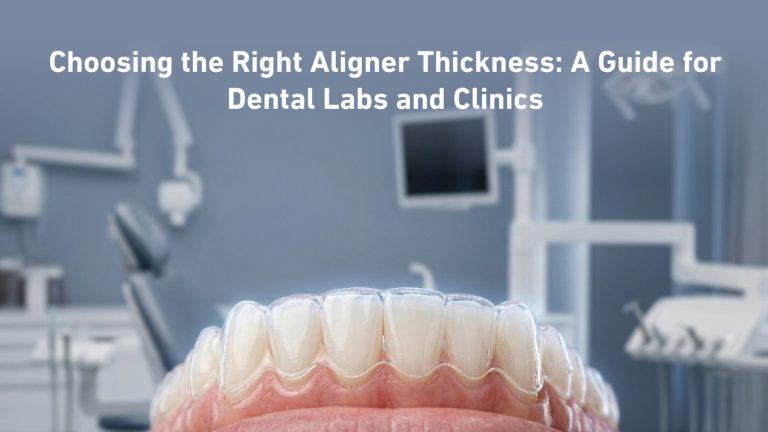
In clear aligner therapy, one of the most practical decisions a clinician or dental lab faces is choosing the right thickness of aligner sheet. Should you go with 0.5 mm or 0.75 mm or something else? It sounds simple, but the answer really depends on what you are trying to achieve and for whom. Let’s discuss more about it.
How Thickness Affects the Force on Teeth?
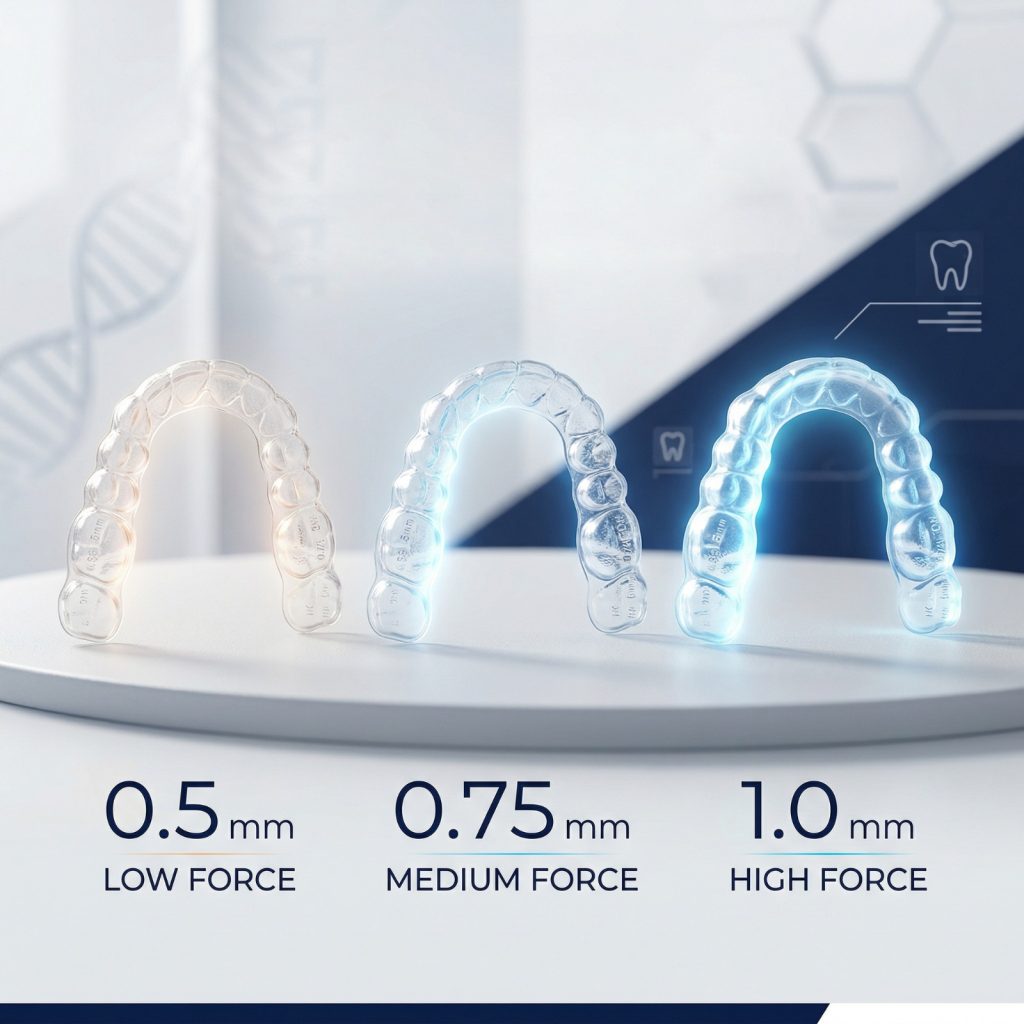
The thicker the aligner, the more force it puts on the teeth and the surrounding ligament. Research shows that 0.75 mm aligners generate significantly higher forces, both when active and at rest, compared to 0.50 mm options.¹ In practice, this translates to real clinical differences: patients treated with 0.75 mm aligners show significantly greater widening of the upper arch and a larger increase in arch perimeter compared to those in 0.50 mm aligners.² Thicker aligners also grip the teeth more firmly. This improved retention matters because it helps ensure the aligner stays fully seated, which is what allows the planned tooth movements to actually happen.¹
The Challenge of Moving a Tooth as a Whole Unit
One of the hardest things to do with clear aligners is to move a tooth bodily, that is, shifting both the crown and the root together in the same direction. By their nature, aligners tend to tip the crown rather than move the whole tooth. To counteract this, thicker and single-layered rigid materials work better.¹ The reason is biomechanical: thicker aligners create a larger force difference between the biting edge and the middle of the tooth, which generates the kind of force couple needed to control root movement.¹ Thinner or multi-layered materials are more flexible and deliver lighter forces,¹ which can be great for comfort, but may not be enough for more complex movements.
What Patients Actually Experience
When patients wearing the two thicknesses were checked, patients using 0.5 mm aligners reported significantly higher satisfaction overall.² Two reasons stand out for this:
– Less pain: Both groups experienced peak pain around four hours after putting in a new aligner, but 0.75 mm aligner wearers consistently reported higher pain levels throughout treatment. ²
– Easier adjustment: Patients using thinner aligners reported adapting to them more easily, both in terms of how they feel and how they look. ²
Which Thickness Should You Choose?
Both 0.5 mm and 0.75 mm aligners are clinically appropriate for mild Class I crowding in the upper arch; they just serve different purposes. ²
– For comfort and early stages: 0.5 mm aligners are the better choice for the start of treatment or for patients who are sensitive to pain. They are lighter, less noticeable, and easier to get used to.²
– For efficient movement and arch expansion: 0.75 mm aligners deliver stronger forces and are the better tool when you need meaningful tooth movement, particularly arch widening. ²
Going Beyond 0.75 mm: The Case for Even Thicker Sheets
While focusing on 0.5 mm and 0.75 mm variants, the biomechanical principle it establishes is clear: greater thickness means greater force delivery and better retention. This logic extends naturally to even thicker options. For cases involving significant bodily movement, severe crowding, or complex multi-plane tooth movements, a 1.0 mm sheet can deliver the additional rigidity and sustained force that neither 0.5 mm nor 0.75 mm may be able to provide on their own.¹ Clinicians managing such cases should not feel constrained to the specific thicknesses studied in the trials. Rather, the evidence supports using thickness as a deliberate clinical variable, scaling up when the case demands greater mechanical control.
A Smarter Combined Approach
Emerging data suggests a hybrid strategy which is worth watching: alternating between flexible multi-layered (or thinner) aligners and rigid single-layered (or thicker) ones within the same treatment phase.¹ The idea is to first use a softer aligner to begin a movement step, making the patient more comfortable, and then switch to a stiffer aligner to lock in the position and better manage root control. This “interchangeable protocol” is promising, though it still needs clinical trials to confirm its effectiveness.¹
The Bottom Line
Choosing between 0.5 mm and 0.75 mm is about balancing clinical efficiency with patient experience. Thicker aligners are better tools for complex tooth movement and arch expansion; thinner aligners give patients a more comfortable ride. By matching the thickness to the stage of treatment and the individual patient’s needs, clinicians can aim for results that are both more predictable and more comfortable.
About Taglus
Taglus is one of the global leaders in thermoforming sheets for orthodontic aligners and retainers. With its thermoforming sheets such as Taglus Premium (PETG) and Taglus PU Flex (polyurethane), available across a full spectrum of thicknesses from 0.5 mm through 1.0 mm and beyond. It makes it possible to match the exact mechanical demands of any treatment phase or case complexity. Whether you need a gentle sheet for early-stage comfort or a rigid, high-force sheet for demanding bodily movements, Taglus has a solution designed for it. Get in touch with us today to find the right Taglus sheet for your practice or lab.
References:
1 – Elshazly TM, Christoph Bourauel, Ismail A, et al. Effect of material composition and thickness of orthodontic aligners on the transmission and distribution of forces: an in vitro study. Clinical oral investigations. 2024;28(5). doi:https://doi.org/10.1007/s00784-024-05662-x
2 – Saniye Merve Cengiz, Merve Goymen. The effectiveness of orthodontic treatment with clear aligners in different thicknesses. Scientific Reports. 2025;15(1). doi:https://doi.org/10.1038/s41598-025-86345-9
Have Questions?
 Talk to us on WhatsApp
Popular Posts
The Real Cost of Remakes: How Thermoforming Material Consistency Impacts Dental Lab Profitability
Thermoforming Sheets for Dental Labs: Choosing Between Taglus Standard, Premium, and Ultra
5 Signs Your Thermoforming Machine Is Costing You More Than It’s Saving
Know More About Us
SignUp To Our Newsletter And Get To Know More About Taglus

Taglus is the global industry leader in the manufacturing of innovative clear Aligner and retainer thermoplastic sheets.

Copyrights@taglus-2026
*Taglus is a trademark of Vedia Solutions
Leave a Reply