


Enquire Form
What Is Creep in Dental Materials and Why Does Long-Term Stability Matter?
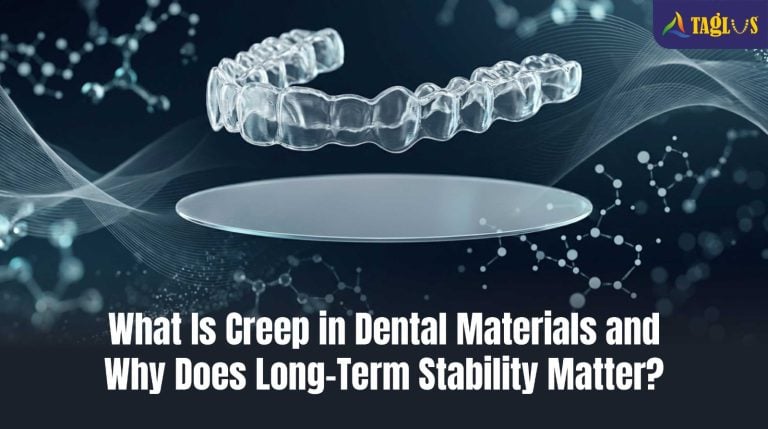
Why Material Stability Decides Treatment Success
Creep in dental materials is defined as the time dependant permanent plastic deformation of a material, to explain in easier terms it the deformation that occurs in a material over a period of time. In terms of aligners, it is the deformation of the biomedical grade plastic that happens over weeks of continuous use. This is important because this affects the shape and their force delivery.
Creep is not visible but it’s an important cause of dimensional change and loss of force delivery. All this needs to be accounted for in the fabrication of any material, if we want to deliver optimum treatment results.
What Is Creep in Dental Materials?
Creep is gradual, permanent deformation under a constant load which occurs over time. Consider a plastic hanger which has been taking the weight of heavy clothes, over a period of time the plastic in the hanger will be deformed due to the weight. This is known as creep. This a material behaviour which is not limited to dental material but can be seen overall in the world.
Dental aligner materials are viscoelastic, that means they are both elastic to an extent and will undergo time dependent deformation.
Why Creep Matters in Clear Aligner Therapy

The aligner is worn over week, where it is expected to be removed and worn multiple times in a day, they undergo a deformation. This can be easily felt by the patient who will definitely tell you that the force that can be felt on the teeth decreases as the days go by. The force that they experience on the first day of any aligner set is more because the creep hasn’t set it. As the days go by the material undergoes deformation and the force is reduced.
This is one of the reasons that the aligner wear schedule is kept for two weeks only.
Normal aligner material is expected to have some creep. Excessive creep is something that the fabricating labs should avoid. When it goes beyond measure it will lead less force delivery and eventually substandard treatment result.
Creep vs. Stress Relaxation vs. Force Decay
| Term | What Happens | Why It Matters |
| Creep | The material deforms more over time under constant load. | The aligner may lose shape and fit. |
| Stress relaxation | The force decreases while the aligner is held at a fixed deformation stage. | The aligner may deliver less force. |
| Force decay | The overall decline in force delivered over time. | It can affect the predictability of tooth movement. |
All of the above-mentioned terms are related but not identical. They all relate to deformation of the aligner, but what happens is different. The associated result is also the same, lessening of the force delivered for tooth movement and eventually less predictability of the treatment outcome.
All of this is clinically very important and hence labs should always opt for aligner sheets which provide reliable data for the same.
What Causes Creep in Aligner Materials?
Polymer Composition
Polymers like PETG, polyurethane, multilayer sheets, and 3D-printed resins behave differently in different conditions.
PETG is stiff and clear but can show early stress relaxation. Polyurethane materials may offer different flexibility and recovery behaviour. Multilayer materials can combine stiffness, elasticity, and comfort.
None of the materials are inherently better but it is very important to select the material ideal for your case.
Temperature and the Oral Environment
The oral environment is demanding. Aligners are typically worn for long periods at approximately 37°C in a humid environment, warm conditions encourage polymer-chain movement and permanent deformation. Saliva and moisture added with constant wear and removal can affect mechanical performance.
This is why lab testing should simulate clinical conditions, not just room-temperature testing.
Moisture and Water Absorption
Water exposure can change an aligner sheet’s mechanical properties and dimensional stability. Materials with higher water absorption are more likely to soften, deform, or show increased creep over time. Because aligners are worn in a warm, moist oral environment, moisture control matters. Keep sheets sealed until use, avoid exposing opened sheets to humidity, and follow the manufacturer’s storage guidance.
Low-water-absorption materials such as, Taglus PU Flex, for example, is designed to limit moisture-related changes and support more stable thermoforming and clinical performance.
Load Duration and Repeated Handling
Aligners deform due to repeated use and time. Continuous wear gives the aligner more time to deform and the repeated removal and insertion add to the mechanical stress.
Chewing forces and daily temperature changes can also contribute to material fatigue. If we want to wear an aligner for longer time, a low creep material becomes vital to maintain force of delivery over the course of treatment.
Thermoforming Process
The thermoforming process affects the final performance of the aligner. Heating, forming pressure, and cooling can change the material’s internal structure and influence how it behaves under load.
Inconsistent thermoforming can produce variable creep behaviour from case to case. Standardizing machine settings by material and following the manufacturer’s guidelines and validated parameters is important to improve repeatability and long-term stability.
What Long-Term Stability Looks Like in Practice
A stable aligner maintains close adaptation throughout the wear period, continues to deliver controlled force, and resists warping, loosening, and permanent deformation. It should also retain optical clarity and surface quality while supporting the planned sequence of tooth movement.
A stable aligner does not just fit well on delivery day; it continues to perform as designed throughout its wear cycle.
How to Evaluate Creep Resistance Before Choosing a Material
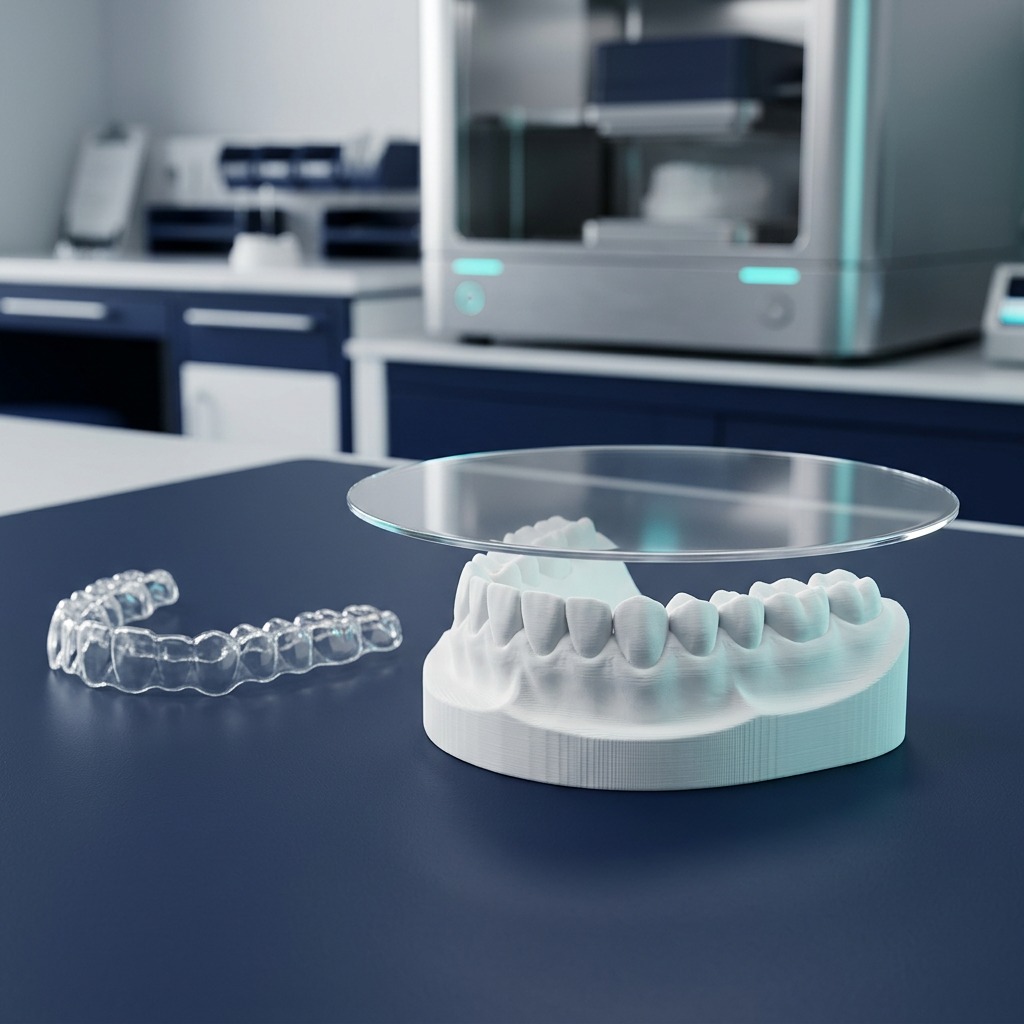
Before selecting a material refer to this practical decision framework.
- Ask manufacturers for creep, stress-relaxation, and force-decay data.
- Review mechanical properties under simulated oral conditions: body temperature and moisture exposure.
- Compare dimensional stability after repeated loading cycles.
- Request technical data sheets and recommended thermoforming parameters.
- Run a controlled in-house trial using the same model, machine, operator, and material batch.
- Inspect finished aligners for fit, clarity, deformation, and force consistency.
How Labs Can Reduce Creep-Related Variability
Some actionable workflow recommendations:
- Store sheets sealed until use.
- Follow material-specific thermoforming settings.
- Calibrate heating elements and pressure systems regularly.
- Use dry, properly cured, dimensionally stable models.
- Allow complete cooling before removal.
- Maintain a QC checklist for fit, clarity, thickness, and deformation.
- Document recurring issues to identify whether the cause is material, machine, or process related.
FAQs
- What is Creep?
Creep is the gradual deformation of a material when subjected to continuous loading. This can cause issues with the fit and force delivery of aligners.
- Why does the force of clear aligners reduce over time?
Clear aligners are made from a material that is prone to creep. The force will decrease due to the changes in the device caused by wear, moisture and continuous mechanical loading.
- Does moisture affect the creep of aligner sheets?
Yes. Water absorption can cause changes in the stiffness, hardness and dimensional stability of the device, making it more prone to creep.
- Can creep be beneficial in clear aligners?
Very small amounts of creep can be beneficial to help distribute excessive force and aid insertion/removal. Too much creep can cause issues with predictability.
- What should labs look for to ensure long term stability of aligners?
Ask manufacturers for creep, stress relaxation and force decay data. Ask for technical data sheets and ideal thermoforming parameters.
Look at the mechanical properties when exposed to oral conditions (body temperature and moisture). Compare the dimensional stability after multiple loading cycles.
Conclusion: Choose Stability, Not Clarity
Creep is a material property and cannot be completely avoided. We can learn to work with creep and even in small amounts make it work for us. However, if left uncontrolled it will cause issues with the whole treatment plan. It is therefore very important to avoid creep.
Looking for an aligner sheet that will provide good thermoforming consistency and long term stability? Look through our Taglus aligner sheet range to find an ideal material for you.
Have Questions?
 Talk to us on WhatsApp
Know More About Us
SignUp To Our Newsletter And Get To Know More About Taglus

Taglus is the global industry leader in the manufacturing of innovative clear Aligner and retainer thermoplastic sheets.

Copyrights@taglus-2026
*Taglus is a trademark of Vedia Solutions
Leave a Reply