


Enquire Form
The Real Cost of Remakes: How Thermoforming Material Consistency Impacts Dental Lab Profitability
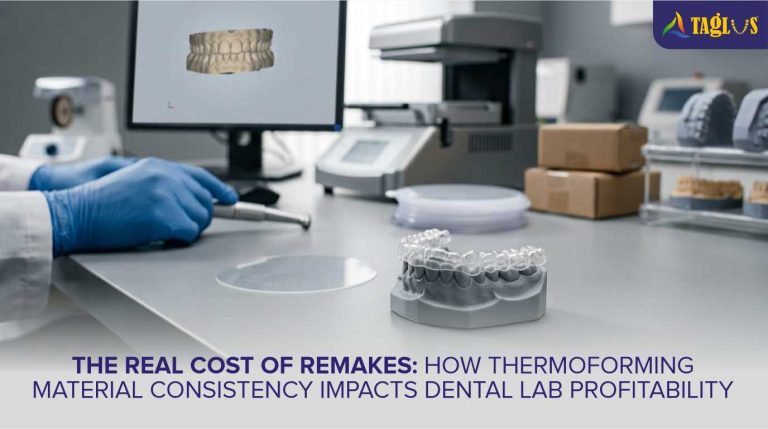
Ask most lab owners what a remake costs, and they will probably point at the sheet. That is understandable, but it is also only part of the picture. A single failed aligner, retainer, or thermoformed appliance usually carries far more cost than the material itself, and thermoforming material consistency has a lot to do with why some labs deal with this problem more than others.
Why Thermoforming Material Consistency Really Matters
Thermoforming, at its core, depends on a sheet behaving in a way you can predict. Heat it a certain way, apply a certain amount of pressure or vacuum, and it should soften, stretch, and adapt to the model in roughly the same manner every time. When that holds true, a lab can settle into a set of processing parameters and more or less trust them.
The trouble starts when it fails to perform in a predictable manner consistently. If a sheet from one batch softens a little faster, or stretches a little differently, than the last one, operators are left compensating on the fly. Sometimes that means adjusting heating time. Sometimes it means a slightly longer forming cycle. Either way, it introduces a variable that should not really be there, and that variable tends to show up later as thinner spots, uneven surfaces, or appliances that simply do not fit as intended.
To be fair, material is not the only culprit. Machine calibration, heating conditions, model design, and operator technique all play a role in how an appliance turns out, and it would be misleading to pin every failed case on the sheet alone. What consistent material does, though, is remove one source of uncertainty from an already complex process. That is arguably its biggest value: not that it guarantees a perfect result, but that it lets a lab trust its own settings rather than second-guessing them with every new batch.
This matters just as much at the batch level as it does sheet to sheet. A lab that buys thermoforming material regularly needs it to behave the same way this month as it did last month. If a new batch behaves differently enough to force a change in process, that is its own quiet cost, even before a single appliance fails.
There is also a training angle worth mentioning. New technicians learn a process, not a material’s quirks. When material behaviour shifts unpredictably, that learning curve gets steeper, and it becomes harder to tell whether a mistake was caused by inexperience or by the sheet itself.
What a Remake Actually Costs
Producing an appliance is not one step, it is several: model preparation, thermoforming, trimming, finishing, inspection, packaging, and delivery. A remake does not just repeat the thermoforming stage, it tends to drag most of that sequence back with it.
That means the technician’s time is gone, and it cannot really be recovered. The machine is occupied again. Finishing and quality-control steps have to be redone. In a lab handling a handful of cases a day, this might be a minor irritation. At real volume, even a small remake rate starts eating into capacity that should be going toward new cases rather than fixing old ones.
The Knock-On Effect on Turnaround
Remakes rarely stay contained to the lab. When an appliance has to be reproduced, delivery to the practice slips, and in orthodontic workflows where cases run on a schedule, even a short delay can cause complications further down the line. So while it is tempting to think of remakes purely in terms of cost, they are just as much a service issue. A lab that produces consistently is, by extension, a lab that is easier to rely on.
Tracking Remakes Properly
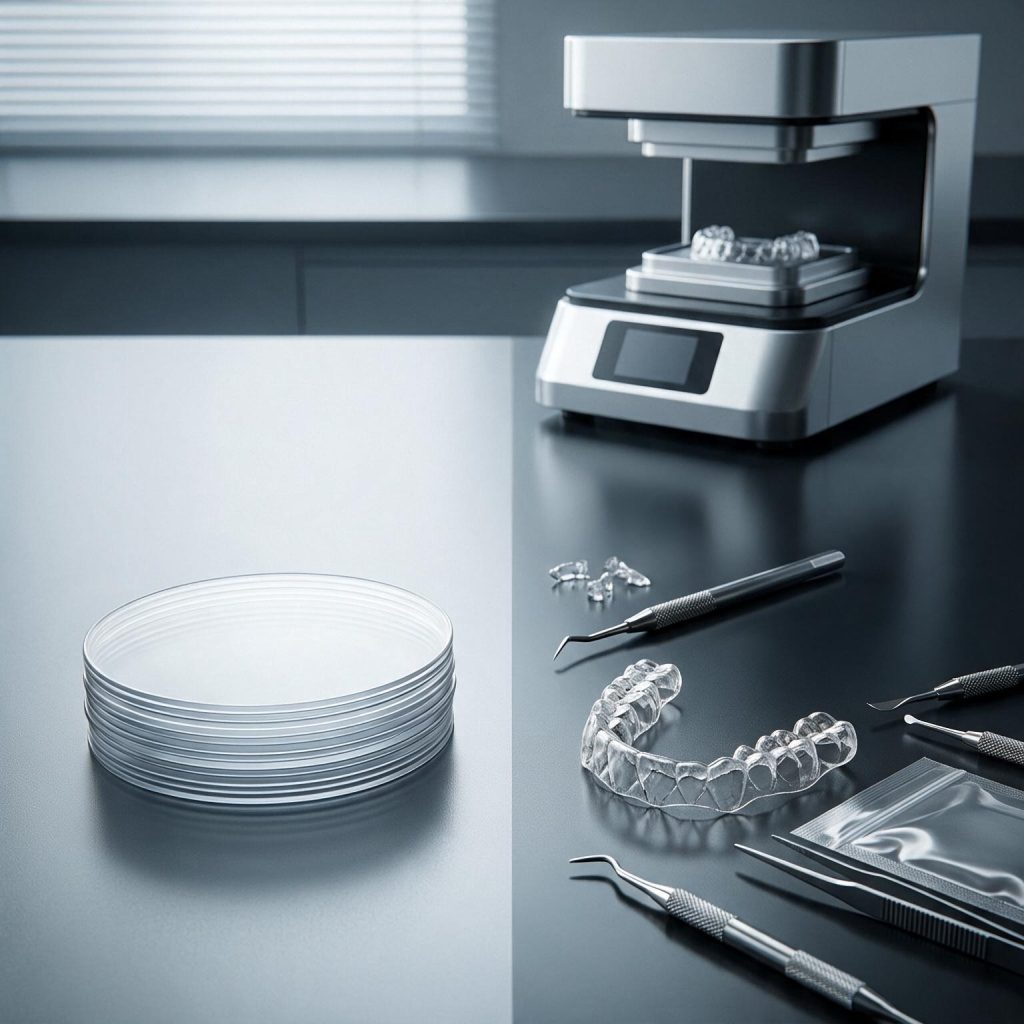
Most labs record that a remake happened. Fewer record why. That distinction matters, because the reasons tend to reveal patterns, whether it is thermoforming behaviour of the material, machine performance, model preparation, or finishing, and patterns are what actually let you fix something rather than just absorb the cost each time.
If thermoforming inconsistency keeps showing up as the reason, it is probably worth reviewing the material alongside machine calibration and heating parameters together, rather than assuming it is a single fault. The point is not to chase a zero-remake number, which is unrealistic given how many variables a dental workflow involves, but to understand which ones are actually within your control.
Choosing Material Is a Business Decision, Not Just a Purchasing One
It is easy to treat a thermoforming sheet as a line item and pick whichever one is cheapest per unit. The problem is that price per sheet does not capture how a material behaves once it is on the machine, how much adjustment it demands from operators, or how often it ends up contributing to rework. A material that looks like a saving on paper can turn out to be more expensive once you factor in the rework it quietly causes.
Looked at this way, material selection is less about the invoice and more about production efficiency over time. Consistency, predictable processing, and finished-appliance quality all feed into what a material actually costs a lab, and that figure often looks quite different from the sticker price.
Bringing It Together
None of this comes down to one fix. A dependable thermoforming process needs consistent material, properly calibrated equipment, controlled heating, trained operators, and quality control that actually catches issues early, all working together rather than in isolation. Get those working together, and the unnecessary variation tends to fall away on its own.
At Taglus, we manufacture thermoforming materials engineered for consistency, sheet after sheet and batch after batch. That reliability is what gives labs a stable foundation to build their processes around, rather than adjusting for every new delivery. To learn how our materials can help you reduce remakes and increase your profitability, contact us today.
Have Questions?
 Talk to us on WhatsApp

Know More About Us
SignUp To Our Newsletter And Get To Know More About Taglus

Taglus is the global industry leader in the manufacturing of innovative clear Aligner and retainer thermoplastic sheets.

Copyrights@taglus-2026
*Taglus is a trademark of Vedia Solutions
Leave a Reply