


Enquire Form
Glass Transition Temperature: What It Actually Means for Thermoforming
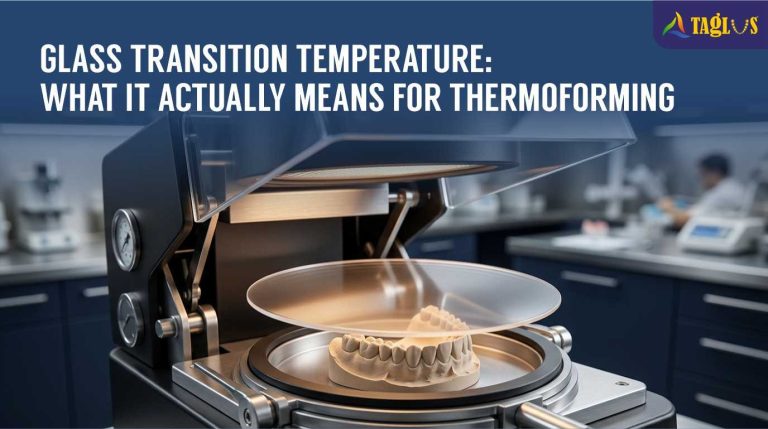
You must have been thinking about why the thermoforming sheet acts so differently after it is placed inside the thermoforming machine; this generally always comes to one factor: Glass Transition Temperature or Tg. It sounds technical, and in a sense, it is, but the idea behind it is fairly simple once you break it down. Understanding Tg can help you make sense of why certain sheets adapt better than others, why heating time matters, and why two materials that look almost identical can still perform quite differently on the same machine.
What Is Glass Transition Temperature (Tg)?
Glass Transition Temperature is described as the temperature at which a polymer becomes flexible by transitioning from its rigid form into a pliable one. Below the Tg point, the polymer remains rigid. With the progression into the glass transition region, the chains of the polymer molecules acquire enough energy to move about and thus become flexible. Above Tg, it reaches a state that is generally easier to shape.
It helps to be clear about one thing early on: Tg is not the same as melting point. A sheet does not turn liquid at its glass transition temperature. What actually changes is the mechanical behaviour of the material, not its physical state. So, while a polymer might feel noticeably softer once it passes Tg, it is still very much a solid, just a more workable one.
Why This Matters When You’re Forming a Sheet
Thermoforming, at its core, involves heating a sheet until it reaches a workable condition, placing it over a model, and using vacuum or pressure to shape it. Getting that heating stage right tends to make a real difference to the outcome.
If a sheet is not heated enough, it can stay too stiff to properly follow the contours of the model. Undercuts, tooth surfaces, and finer details may not be captured as well as they should be. On the other hand, overheating brings its own problems. A sheet that gets too soft can be harder to control during forming, and this is often where you see uneven thickness, unwanted stretching, or slight distortions in the finished piece. Neither extreme is particularly helpful, which is why staying within a suitable thermal window tends to matter more than simply cranking the heat up or down.
This is also where consistency comes in. Thermoforming is rarely just about temperature on its own. It is really a combination of heat, timing, pressure, or vacuum, and how the material itself responds to all of that. When labs understand roughly where a material’s Tg sits, they are in a better position to set up a process that produces similar results appliance after appliance, rather than one that varies from batch to batch.
Tg Versus Melting Temperature
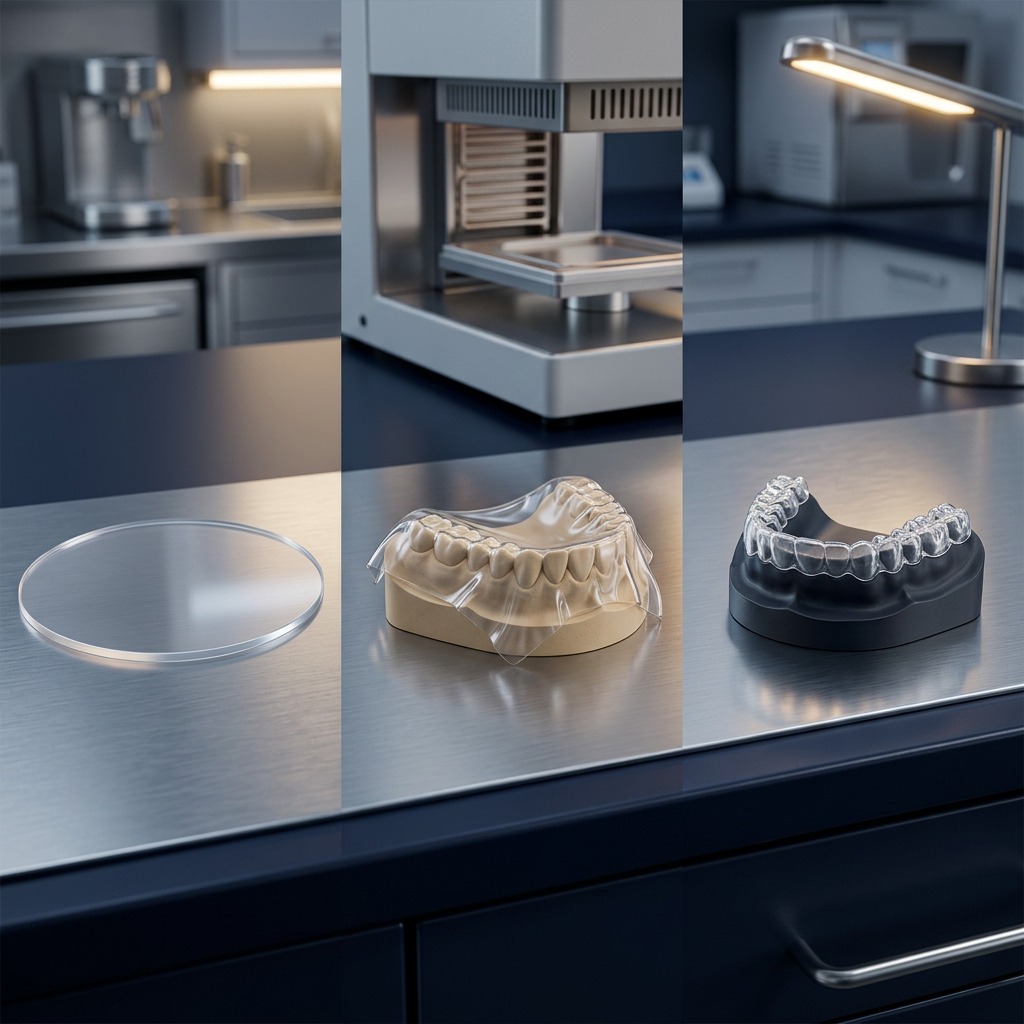
It is a common assumption that thermoforming works a bit like melting plastic, but that is not quite accurate. Most thermoforming materials are heated into a soft, formable range well before they would ever reach a true melting point.
| Glass Transition Temperature (Tg) | Melting Temperature (Tm) | |
| What happens | Polymer shifts from rigid to soft and rubbery | Crystalline regions break down and melt |
| Material state | Becomes flexible | Becomes molten |
| Is it a liquid? | No | Yes, once well above Tm |
The distinction matters because it shapes how you should think about heating in the first place. You are not trying to liquefy the sheet. You are trying to bring it into a controlled, workable condition.
Tg Is Only Part of the Picture
It would be misleading to suggest that Tg is the only thing that determines how a sheet forms. In practice, several other factors play a role too, including the specific polymer formulation, sheet thickness, heating method and duration, forming pressure or vacuum strength, model geometry, and how well the machine itself is calibrated.
Two sheets designed for similar applications can still behave quite differently once formulation and thickness are taken into account. This is really why following the manufacturer’s recommended processing parameters matters more than relying on general assumptions about temperature.
Machine calibration deserves a mention here as well. Even a well-formulated sheet can produce inconsistent results if heating elements, sensors, or vacuum/pressure performance are not properly maintained. For labs producing aligners and retainers at any real volume, this kind of consistency often ends up mattering just as much as the quality of any single appliance.
What Happens at the Extremes
When a sheet does not get enough heat, you tend to see incomplete adaptation to the model, less detail reproduction, and more resistance during forming. The exact severity depends on the material and machine involved, but the pattern is fairly consistent.
Too much heat causes a different set of issues. The sheet becomes harder to control, and this can lead to excessive stretching, thickness variation, or slight deformation once it cools. More heat is not automatically better, which is a point worth remembering when troubleshooting forming issues.
Bringing It Back to Practice
Understanding Tg gives dental professionals and lab technicians a useful lens for thinking about why a sheet behaves the way it does under heat. As temperature rises, polymer chains gain mobility, and somewhere around the glass transition region, that mobility becomes enough to shift the material from rigid to workable. That single change underpins a lot of what happens later in the process, from how well a sheet adapts to a model to how consistent the final thickness turns out to be.
Thermoforming can look deceptively simple from the outside: heat a sheet, form it, let it cool. But there is a fair amount of material science sitting behind that process, and Tg is one of the more important pieces of it.
At Taglus, this is exactly the kind of thinking that shapes how thermoforming solutions are put together. Taglus offers an end-to-end thermoforming solution, built around advanced thermoforming materials engineered for a consistent glass transition temperature, so labs and orthodontic practices can rely on predictable, repeatable forming, batch after batch. To know more about Taglus thermoforming solutions, contact us today.
Have Questions?
 Talk to us on WhatsApp

Know More About Us
SignUp To Our Newsletter And Get To Know More About Taglus

Taglus is the global industry leader in the manufacturing of innovative clear Aligner and retainer thermoplastic sheets.

Copyrights@taglus-2026
*Taglus is a trademark of Vedia Solutions
Leave a Reply