


Enquire Form
Top 5 Mistakes Labs Make While Thermoforming Clear Aligners
A practical guide for dental labs and clinicians who want predictable results
Clear aligners look simple from the outside. A thin, transparent shell that gently moves teeth. But anyone who has worked inside a dental lab knows the truth. The success of an aligner case is decided long before it reaches the patient. It is decided at the thermoforming stage.
For labs, thermoforming is not just a manufacturing step. It is where material science, machine control, handling discipline, and clinical understanding come together. Small errors here do not stay small. They show up later as poor fit, loss of force, mid-course corrections, or unhappy clinicians.
In this blog, we break down the top five mistakes labs commonly make unknowingly while thermoforming clear aligners, why they happen, and how labs and dentists can prevent them.
Overheating or Underheating the Aligner Sheet
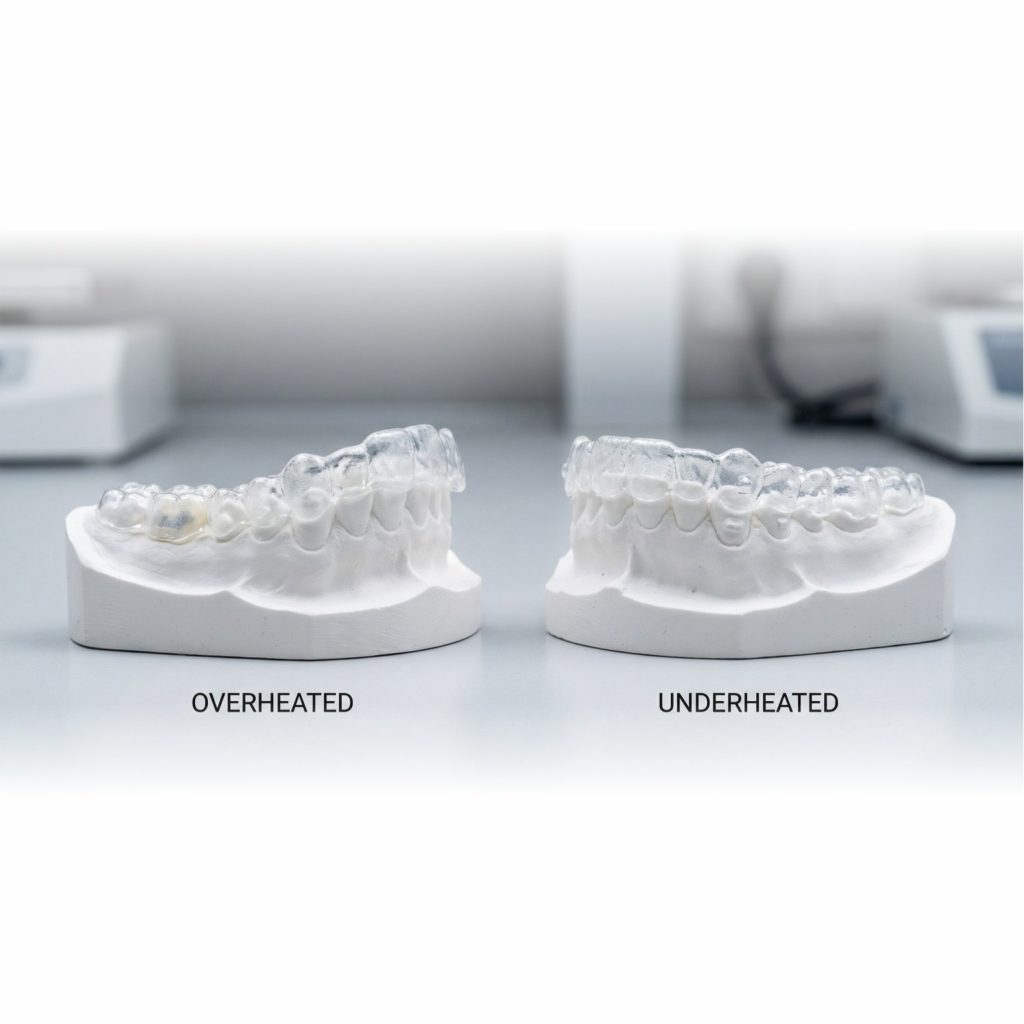
Thermoforming starts with heat, but heat without control is one of the biggest problems in aligner fabrication.
Many labs rely on visual cues alone, waiting for the sheet to “look ready.” The problem is that different materials respond differently to heat. PETG, PU, and multilayer sheets each have their own ideal forming window. When this window is missed, performance drops.
What happens when the sheet is overheated
- Material thins unevenly
- Force delivery becomes unpredictable
- Increased risk of cracking during trimming or wear
What happens when the sheet is underheated
- Poor adaptation to the model
- Loss of detail around attachments and margins
- Reduced retention
Key takeaway for labs
Thermoforming should be driven by material-specific temperature and sag guidelines, not guesswork.
Common Heating Errors and Their Impact
| Error Type | What Labs Do | Result in Final Aligner |
| Overheating | Heat beyond recommended temp | Weak force, thinning, early fatigue |
| Underheating | Form too early | Poor fit, rebound, low retention |
| Inconsistent heating | No standard protocol | Case-to-case variability |
Ignoring Sheet Thickness Loss During Forming
Every thermoforming process reduces sheet thickness. This is normal. The mistake is not accounting for it.
Labs often select aligner sheet thickness based on the final desired force, but forget that forming, stretching, and trimming all reduce thickness. What starts as a 0.75 mm sheet may end up significantly thinner in critical areas.
This directly affects force expression and aligner staging accuracy.
Why this matters clinically
- Tooth movement may stall
- Planned biomechanics do not match reality
- Dentists assume planning errors when the issue is fabrication
What smart labs do differently
- Select sheet thickness based on post-forming thickness, not pre-forming
- Track average thickness loss per machine and material
- Standardise material usage per indication
- Poor Model Preparation Before Thermoforming
- No aligner can be better than the model it is formed on.
- Rough surfaces, printing artefacts, incomplete curing, or sharp edges on models are silent killers in thermoforming. The aligner may look fine at first glance, but problems appear during wear.
Common model-related issues
- Rough surfaces cause micro-tears
- Sharp edges thin the material excessively
- Incomplete curing leads to distortion during heating
For dentists, this often shows up as aligners that feel tight in some areas and loose in others, even in simple cases.
Best practices labs should follow
- Fully cure and cool models before forming
- Smooth support marks and rough surfaces
- Inspect margins and attachment areas closely
Model Quality Checklist
| Model Issue | Impact on Aligner | Clinical Outcome |
| Rough surface | Material stress | Cracks, discomfort |
| Sharp edges | Over-thinning | Loss of force |
| Incomplete curing | Warping | Poor fit |
Inconsistent Pressure or Vacuum Control
Thermoforming machines are only as good as how consistently they are used.
Many labs do not routinely check pressure or vacuum levels. Over time, filters clog, seals wear out, and pressure drops. The aligner still forms, but not optimally.
Why this mistake is dangerous
- Subtle fit issues go unnoticed
- Problems appear only after delivery
- Remakes increase without a clear reason
- Dentists often report “fit issues in later trays,” which is a classic sign of forming inconsistency rather than planning errors.
Lab-level solution
- Regular machine calibration
- Preventive maintenance schedules
- Documented forming parameters per machine
Pressure Control Impact Table
| Pressure/Vacuum Status | Aligner Fit | Lab Risk |
| Optimal and stable | Accurate, consistent | Low remakes |
| Slightly reduced | Inconsistent adaptation | Higher adjustments |
| Poor control | Visible misfit | Remakes and complaints |
Improper Cooling and Handling After Forming
Once the sheet is formed, the job is not done.
Many labs rush the cooling process to save time. Removing aligners too early or stacking them while warm introduces internal stresses. These stresses may not be visible immediately, but show up during patient wear.
What goes wrong
- Warping over time
- Loss of shape memory
- Reduced lifespan of the aligner
- For clinicians, this often means aligners that fit on day one but feel different after a few days.
Correct approach
- Allow full cooling on the model
- Avoid forced cooling unless material allows
- Handle aligners gently during trimming
Cooling Errors and Consequences
| Cooling Practice | Short-Term Look | Long-Term Effect |
| Proper cooling | Stable shape | Predictable wear |
| Early removal | Looks fine | Gradual distortion |
| Forced cooling | Faster output | Internal stress |
Final Thoughts for Labs and Dentists
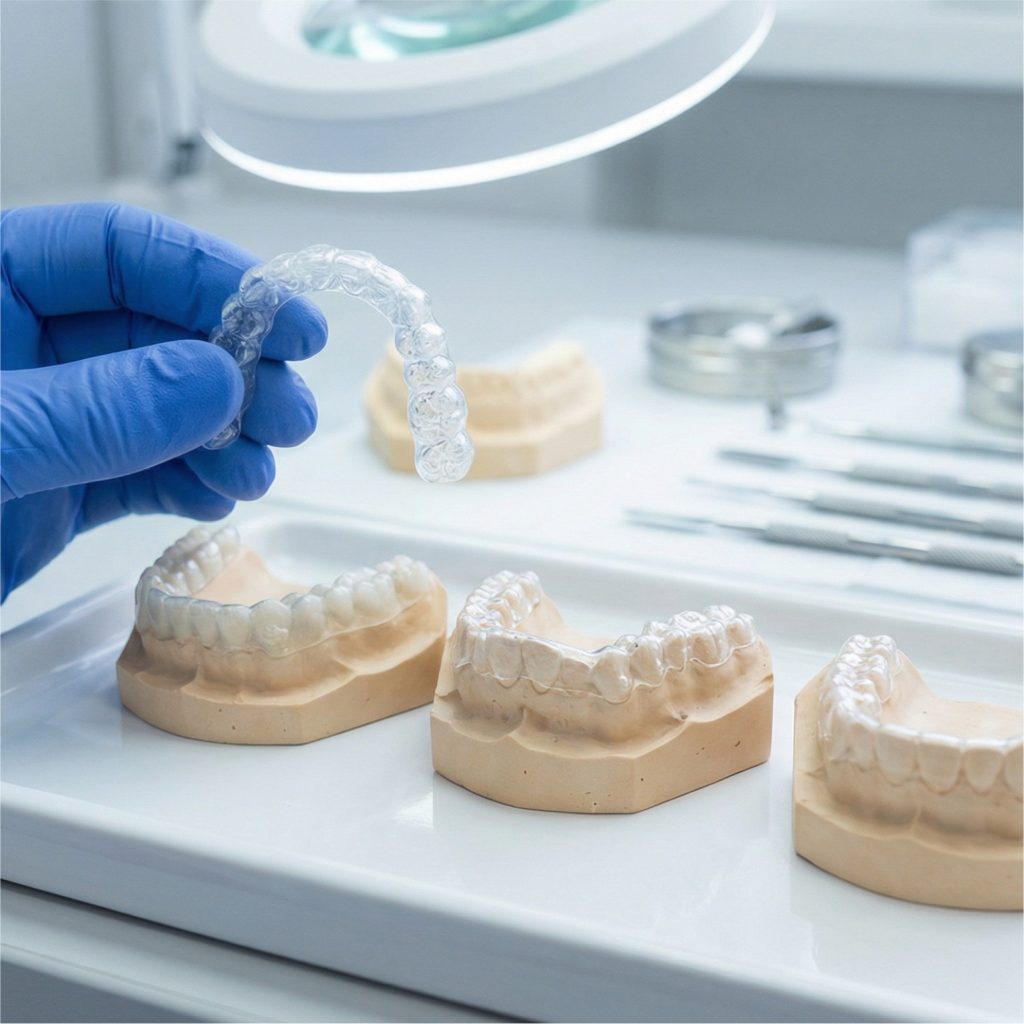
Thermoforming is where planning meets reality.
For labs, mastering this step means fewer remakes, happier clinicians, and stronger trust. For dentists, working with labs that respect material science and process control means more predictable outcomes for patients.
High-quality aligners are not accidental. They are the result of discipline, consistency, and understanding every variable in the thermoforming process.
At Taglus, the focus has always been on supporting labs with material systems that are engineered for consistency, reliability, and clinical confidence. But even the best materials perform only as well as the process behind them.
When thermoforming is done right, everyone wins. The lab. The dentist. And most importantly, the patient.

Know More About Us
SignUp To Our Newsletter And Get To Know More About Taglus

Taglus is the global industry leader in the manufacturing of innovative clear Aligner and retainer thermoplastic sheets.

Copyrights@taglus-2026
*Taglus is a trademark of Vedia Solutions

Leave a Reply