


Enquire Form
How ISO Standards & FDA Regulations Affect the Quality of Aligner Materials?
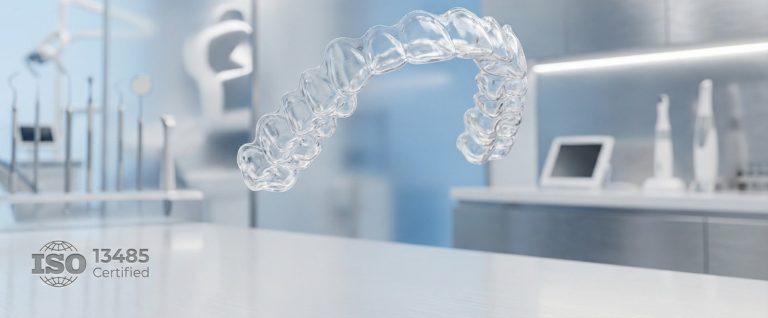
ISO stands for International Organisation for Standardization whereas FDA stands for US Food and Drug Administration. ISO is an international, non-governmental organisation that develops voluntary standards to support quality, safety, and consistency in medical devices, whereas the FDA is a U.S. government body that sets rules and ensures products are safe and effective. They have set benchmarks of quality that any new dental or medical device manufacturer must adhere to. For aligners, such standards require manufacturers, through regulatory and quality frameworks, to undergo rigorous testing and maintain continuous quality while meeting the required treatment objectives. What is the difference between ISO standards and FDA regulations, and how do they affect the quality of aligner materials? Let’s find out.
ISO:
ISO standards are made to improve patient safety. There are multiple ISO standards which are designed to support the design, manufacture, and quality management of different types of medical devices. The risk category and intended use, along with multiple other factors, affect the ISO standard. The material/device must follow these standards, ensuring safety and consistent quality.
ISO 13485 is one such ISO standard which is followed as a quality management system in the medical device industry, supporting consistent quality and safety throughout the design, development, production, and distribution processes.
The processes and systems of aligners that comply with ISO 13485 ensure documented control of the manufacturing process with respect to material quality and regulatory requirements.
ISO standards provide a broad framework for best practices, safety, and quality. This determines the reliability, safety, and quality of medical devices.
For aligners, this means that it meets the quality, biocompatibility and performance criteria that are required for supporting safe and effective treatment. It also supports strict control over manufacturing processes. This ensures that each and every aligner produced is safe, comfortable, and reliable for patient use.
FDA 510(k) Clearance:
Aligners are categorised as Class II medical devices by the FDA, which means that they have to follow strict safety, performance, and manufacturing requirements before they can be used on patients. The devices need to show substantial equivalence to a predicate device in terms of safety, performance, and intended use.
Clear aligners receive FDA 510(k) clearance by proving they match cleared predicates in material composition and clinical function, without requiring full clinical trials for efficacy.
Biocompatibility details, such as cytotoxicity and sensitisation studies, have to be provided, which helps identify and mitigate risks associated with unsafe materials. FDA clearance indicates there is compliance with baseline safety and performance requirements. It does not necessarily imply better mechanical properties, such as shear strength or colour stability, compared to non-cleared materials. The cleared materials meet minimum requirements, which lowers the risks to patients, such as allergic reactions. An FDA clearance assures safety, particularly important in the US.
Importance for Dental Professionals:

For dental professionals, certified or compliant materials reduce litigation risk and enhance patient trust by building credibility and reliability amongst them. The consistent quality of aligners increases the predictability of the treatment and provides a satisfactory treatment outcome.
Limitations and Gaps:
1 – Perpetuate Flaws: Regulations like FDA 510(k) relies on prior devices; flaws in predicates propagate without mandating improvements.
2 – Delays in Innovation: Any novel product may take slightly longer to get FDA approval because of the absence of predicates.
3 – Patient/Clinical Factors: Compliance, planning, and attachments influence results more than material certification alone. Hence, practitioners should stay careful while marketing the certifications, as it does not guarantee successful orthodontic results.
4 – Global Disparities: Not all markets have strong regulatory systems. In such regions, product safety and quality checks may be limited or inconsistent.
Practical Recommendations for Clinicians
- Verify 510(k) numbers on IFUs; cross-check with the FDA database for the latest clearances.
- Prioritize ISO compliant materials for your patients.
- For custom workflows, audit suppliers for dual FDA/ISO documentation to ensure global regulatory compliance.
- Educate patients on the importance of regulatory standards via leaflets highlighting BPA-free status and durability, among others.
Taglus Aligner Materials:
Taglus is one of the top manufacturers of thermoforming materials globally, with products compliant with regulatory requirements across multiple international markets. Depending on the region and product category, these include certifications such as CE, UKCA, TGA, and ANVISA, carrying regulatory approvals from various regions of the world. Taglus adheres to the ISO (13485:2016) QMS norm. The aligner materials have shown outstanding physical properties such as tensile strength, impact strength, and elongation at break. They have passed biocompatibility tests such as skin sensitisation, in vitro cytotoxicity, and skin irritation tests as per the guidelines. So, if you are looking for a reliable aligner material partner, reach out to Taglus today.
Conclusion:
Certifications and international regulatory standards enhance the basic quality of materials by screening out harmful substances. These standards have helped convert aligner materials from research-grade polymers to trusted therapeutics, reducing biological hazards while bringing successful orthodontic results. With the advancement of digital technologies, certifications will help bring about an element of sustainability, too. Dental practitioners need to be updated, integrating the assurance of regulatory standards and certifications with expert knowledge for the best possible patient outcomes.
Know More About Us
SignUp To Our Newsletter And Get To Know More About Taglus

Taglus is the global industry leader in the manufacturing of innovative clear Aligner and retainer thermoplastic sheets.

Copyrights@taglus-2026
*Taglus is a trademark of Vedia Solutions

Leave a Reply