


Enquire Form
Understanding FDA and CE Compliance for Aligner Materials in 2026
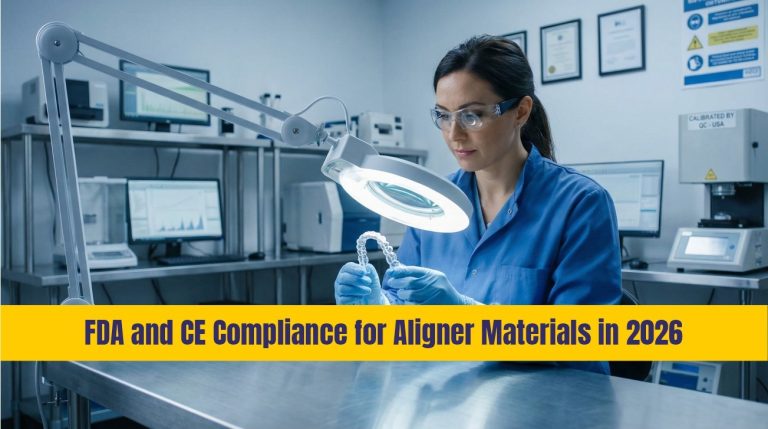
The clear aligner industry has revolutionised the way millions of people approach teeth straightening. Heading into 2026, adherence to FDA and CE compliance for aligner materials is more important than ever. Patients are demanding to know more about what goes into their bodies, and dental professionals must work with orthodontic materials that pass the most stringent safety tests.
What Are FDA and CE Compliance for Aligner Materials?
FDA compliance includes meeting the rigorous safety guidelines laid down by the US Food and Drug Administration, which is the US federal agency responsible for public health. Once a medical device gets FDA clearance, the manufacturer has basically demonstrated that the product is both safe and effective and won’t cause any damage to users in normal conditions.
CE compliance is not all that different, in that it’s the European equivalent of FDA compliance, but it’s aimed at the European market. The CE mark, which stands for Conformité Européenne, basically certifies that a product meets the primary health and safety needs of the European Union. For orthodontic appliances, like clear aligners, manufacturers in the EU need to prove that their products comply with the Medical Device Regulation, which is the updated framework that supplanted the previous directives.
While these two systems operate in different regions, they are ultimately working toward the same goal: protecting patients by making sure medical devices are safe, effective, and consistently high-quality before anyone can access them.
Why Does Regulatory Compliance Actually Matter?
These certifications are incredibly important, considering orthodontic aligners sit in the patient’s mouth for hours every day, constantly interacting with their oral tissues, saliva, and everything else in that environment.
Anything which interacts with the body should not release harmful chemicals or cause any other kind of allergic reactions. At the same time, it should be stable and strong enough to achieve the desired treatment objectives without causing any harm to the patient or derailing the treatment due to any other reason.
Such regulatory bodies protect professionals and consumers from potential pitfalls or side effects that can take place because of any ignorance or negligence. It guarantees that materials have passed biocompatibility tests.
Further, such regulatory bodies require manufacturers to maintain strict quality management systems. The compliance strictly requires every batch to follow the same quality benchmarks. This is usually done through extensive quality checks and tracking from the initial step to the final finished product.
Compliance Criteria for Aligner Materials
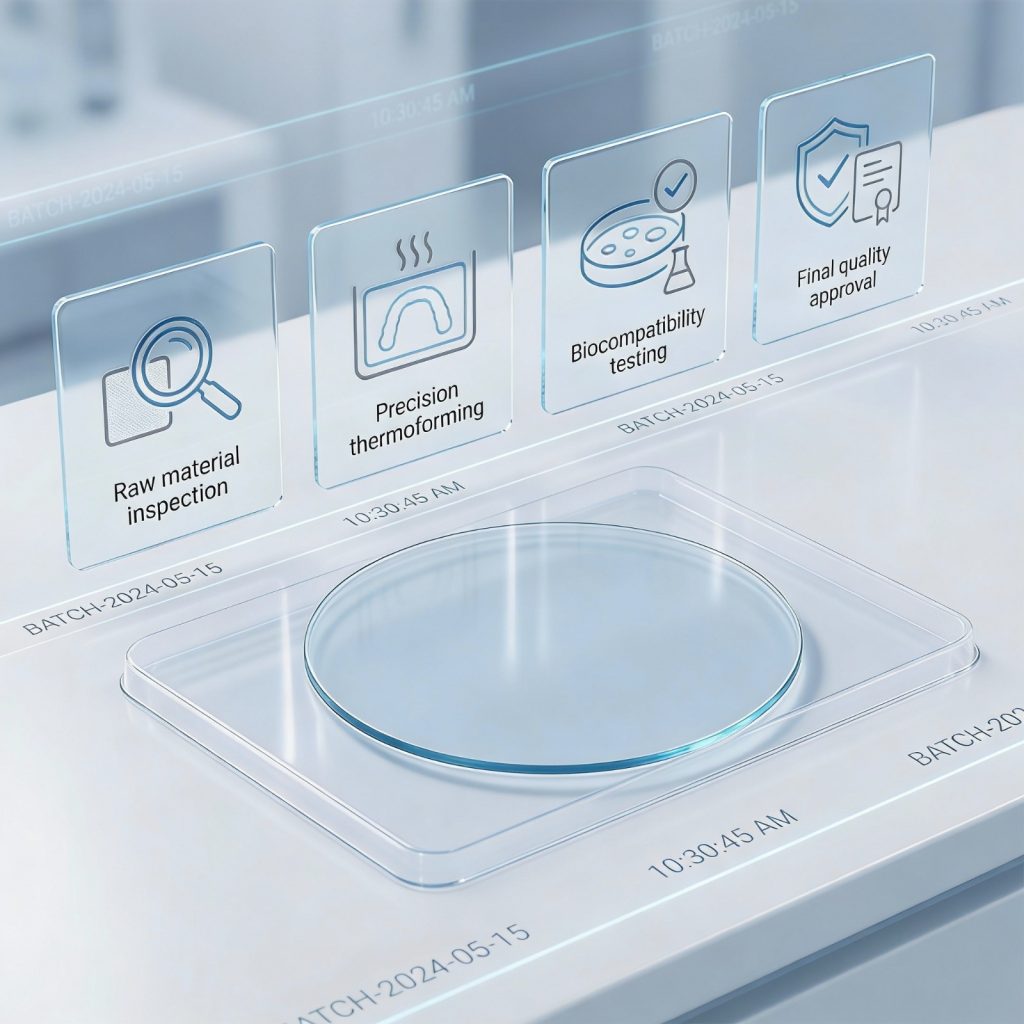
The regulatory requirements for aligner materials are comprehensive and demanding. Biocompatibility testing is perhaps the most crucial aspect. Materials must pass a series of tests that evaluate cytotoxicity (effects on cells), sensitisation potential (allergic reactions), and irritation to tissues. These tests follow internationally recognised standards like ISO, which provides a framework for the biological evaluation of medical devices.
Chemical characterisation is another key requirement. Every manufacturer must know the potential side effects of a particular material or device being manufactured. With regards to materials like aligners, they need to test the material for residual monomers, additives, and any degradation products that might form over time. The levels of any extractable substances must fall well within established safety limits.
The physical and mechanical properties must also be evaluated. With regards to aligners, the appliance must maintain its structural integrity throughout the treatment period. The aligners are required to deliver consistent force while providing comfortable wear experience to patients. Such regulatory bodies perform tests to ensure the materials won’t crack, discolour excessively or lose their mechanical properties while in the mouth.
Also, the manufacturers are required to demonstrate that they can consistently produce materials that meet all specifications.
Taglus: Our Commitment to Quality and Your Safety
We have a simple rule: always put safety and quality first. That’s why our manufacturing facilities are FDA registered. Taglus carries CE approval along with many other global certifications, meeting the rigorous standards of the world’s top regulators.
But certifications are just the beginning. We operate under ISO 13485 certification, our materials undergo extensive testing, and we are constantly improving our processes.
From sourcing raw materials to final testing, every step is carefully controlled and documented.
Innovation is what drives us forward, but for us, patient safety always comes first.
Every new material formulation undergoes complete regulatory testing, so you can be assured of the quality of our latest products.
When you choose Taglus, you’re teaming up with a company that cares about your patients. We handle the rules so you can focus on offering great patient care.
Want to see what makes Taglus different? Get in touch to learn about our materials and how we can help you build the efficiency of your thermoforming workflow.
Know More About Us
SignUp To Our Newsletter And Get To Know More About Taglus

Taglus is the global industry leader in the manufacturing of innovative clear Aligner and retainer thermoplastic sheets.

Copyrights@taglus-2026
*Taglus is a trademark of Vedia Solutions

Leave a Reply