


Enquire Form
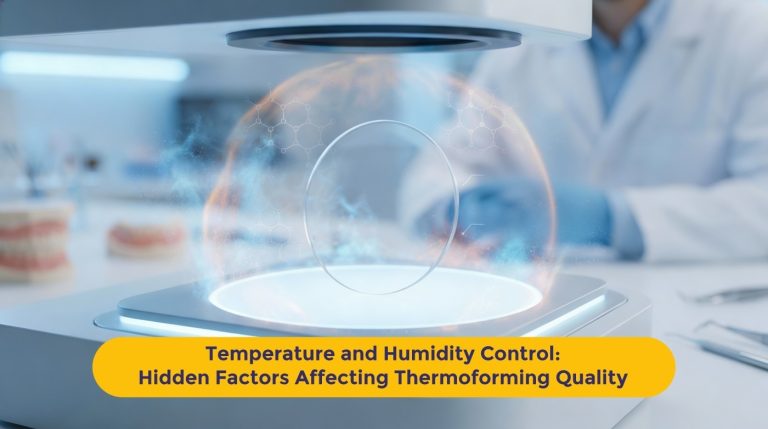
Temperature and Humidity Control: Hidden Factors Affecting Thermoforming Quality
If you are already thermoforming aligners or retainers regularly, you know this truth well.
When something goes wrong, it rarely announces itself loudly.
For instance, the sheet looks fine; the machine’s settings look correct, also the workflow looks unchanged, yet the final aligner feels slightly off.
The dentist notices that the fit is inconsistent, for lab or orthodontist, trimming becomes unpredictable, and complaints quietly increase.
In most such situations, the root cause is not the fault in workflow or thermoforming procedure, or the operator’s fault. It is the environment.
Temperature and humidity are two silent variables that directly influence thermoforming quality. They are often ignored because they do not show up on a settings panel. But they influence material behavior at a molecular level.
This blog breaks down how and why they matter, and how labs can control them for consistent results.
Why Environmental Control Matters in Thermoforming
Thermoforming is not just heating and pressing thermoplastic material.
It is controlled by material transformation.
All the thermoforming sheets are engineered to respond predictably within a defined thermal window. When external conditions fluctuate, the material response also shifts.
So, What changes?
- Softening temperature behavior
- Elastic recovery
- Surface finish
- Thickness distribution
- Final fit accuracy
- Even small variations in ambient conditions can amplify visible quality differences.
Temperature: More Than Just the Heater Setting
Most labs focus only on the heater temperature of the thermoforming unit. That is necessary, but not sufficient. Ambient Room Temperature plays a supportive role as well.
When room temperature is too low:
- Sheets take longer to reach uniform softening
- Surface heating becomes uneven
- Internal stress may remain trapped
When room temperature is too high:
- Sheets may soften prematurely
- Sag control becomes inconsistent
- Material may overstretch before forming
Ideal practice
Maintain a stable room temperature range, typically between 22°C to 26°C, depending on your local climate and equipment.
Consistency matters more than the exact number.
Sheet Storage Temperature
Sheets stored in uncontrolled environments absorb temperature history.
If a sheet has been stored near heat sources or in fluctuating conditions:
- Its response curve shifts
- Heating time becomes unreliable
- Forming behavior changes batch to batch
- TAGLUS sheets are manufactured with tight tolerances. Proper storage ensures those tolerances are preserved until forming.
Best practice
Store sheets in a cool, dry, shaded area.
Avoid stacking near machines, windows, or exhaust vents.
Humidity: The Most Overlooked Variable
Humidity is the most underestimated factor in thermoforming quality. Many labs do not measure it at all.
How Humidity Affects Thermoforming Sheets
Certain thermoforming polymers can absorb moisture from the air over time.
When moisture is present:
- Heating causes micro steam formation
- Surface haze or cloudiness can appear
- Material stiffness changes unpredictably
- Fit accuracy reduces after cooling
- Even if defects are not visually obvious, biomechanical performance may be compromised.
Signs Humidity Is Affecting Your Output
Labs often notice:
- Slight bubbling or texture inconsistency
- Reduced clarity
- Increased post forming shrinkage
- Inconsistent snap fit between cases
These issues often get blamed on the machine or operator skill, while humidity quietly remains the real cause.
Recommended Humidity Control
For aligner and retainer thermoforming:
Ideal relative humidity is typically below 50 percent Sudden humidity spikes are more damaging than stable levels. Simple steps that help:
- Use a digital hygrometer in the lab
- Avoid storing sheets in open air for long durations
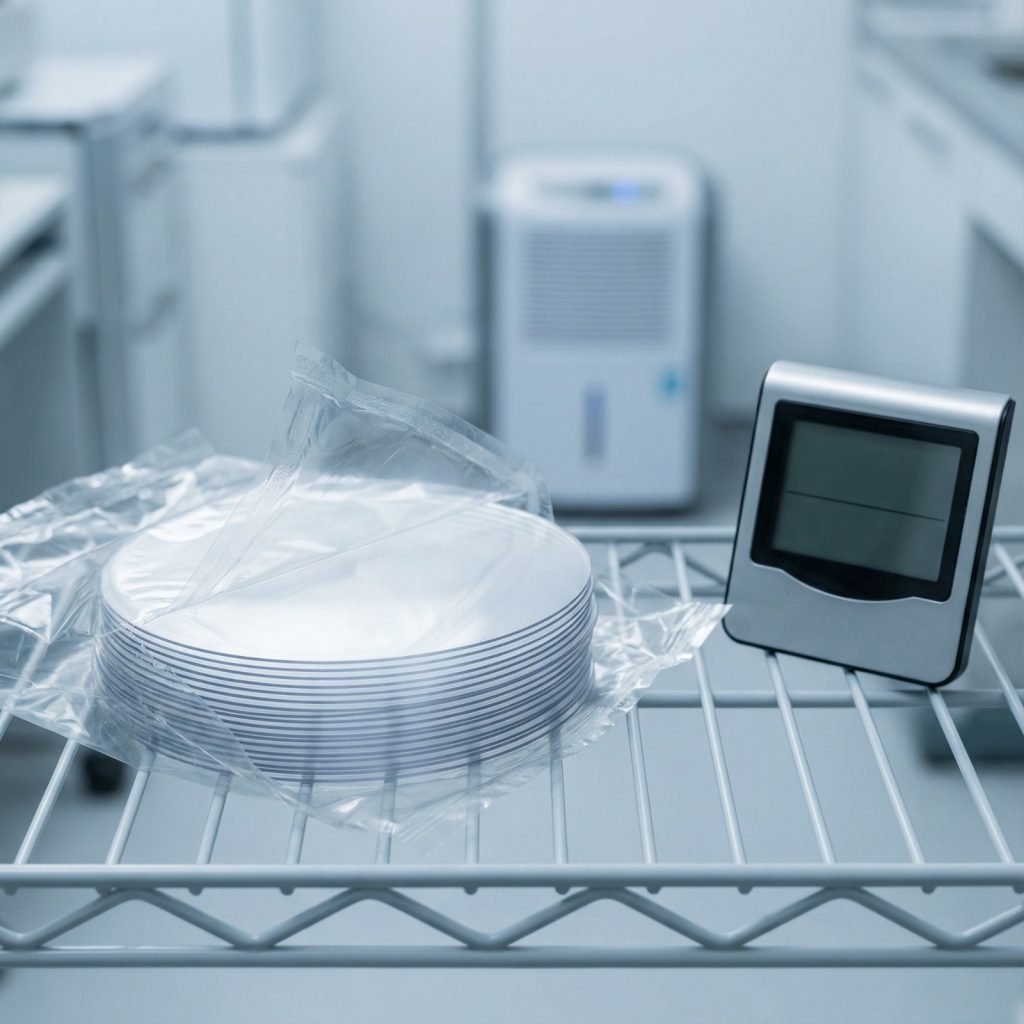
- Seal unused sheets back into protective packaging
- Use dehumidifiers in high humidity regions
Interaction Between Temperature and Humidity
Temperature and humidity do not act independently.
Warm air holds more moisture. High temperature combined with high humidity is the most damaging combination for thermoforming consistency.
This is why labs may notice seasonal variation in output quality even when machine settings remain unchanged.
Machine Warm Up and Environmental Equilibrium
Another overlooked aspect is machine warm up time. Thermoforming machines themselves are influenced by ambient temperature. If a machine is started immediately after a cold night:
- Heater calibration may be temporarily inaccurate
- Heat distribution may be uneven
- Early cases may differ from later ones
- Allowing machines to reach thermal equilibrium before production improves consistency.
Why This Matters More for Multilayer Sheets
Multilayer sheets are engineered with purpose specific layers that balance:
- Strength
- Elastic recovery
- Comfort
- Force delivery
- Environmental instability affects each layer differently.
If humidity or temperature is uncontrolled:
- Layer interaction may change
- Force decay patterns may shift
- Clinical performance can vary
This is why premium materials demand premium process discipline.
Process Control Is the New Differentiator
In today’s aligner market, material quality alone is not enough.
What separates consistent labs from struggling ones is process control. Environmental control is not an expense. It is quality insurance.
When labs control temperature and humidity:
- Reject rates drop
- Fit improves
- Remakes reduce
- Dentist trust increases
Where TAGLUS Fits In
At TAGLUS, we design thermoforming sheets to perform reliably across real world lab conditions. But no material can outperform poor process control.
That is why TAGLUS does not only focus on sheet manufacturing. We care about how sheets are stored, heated, and formed in actual lab environments.
Because at the end of the chain, it is not the sheet that faces the patient.
It is the aligner.
And aligners deserve consistency.
Final Thought
If your thermoforming output feels unpredictable, do not change everything at once.
Start by checking what you cannot see.
- Room temperature.
Humidity levels.
Sheet storage conditions.
Often, the biggest improvements come from controlling the quietest variables.
Know More About Us
SignUp To Our Newsletter And Get To Know More About Taglus

Taglus is the global industry leader in the manufacturing of innovative clear Aligner and retainer thermoplastic sheets.

Copyrights@taglus-2026
*Taglus is a trademark of Vedia Solutions

Leave a Reply