


Enquire Form
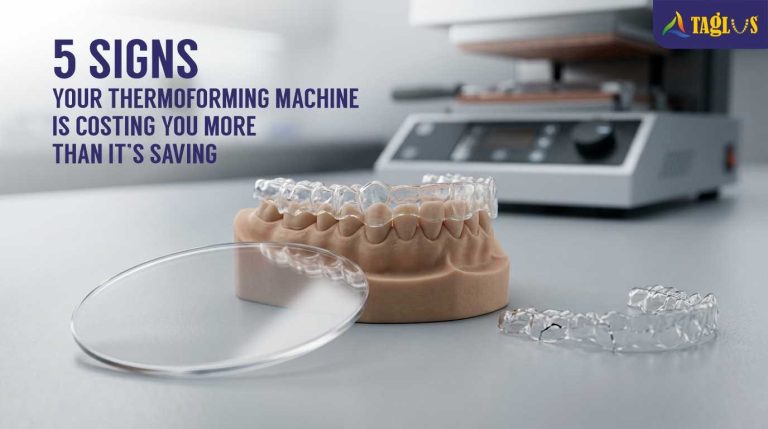
From Sheet to Aligner: Understanding the Thermoforming Process
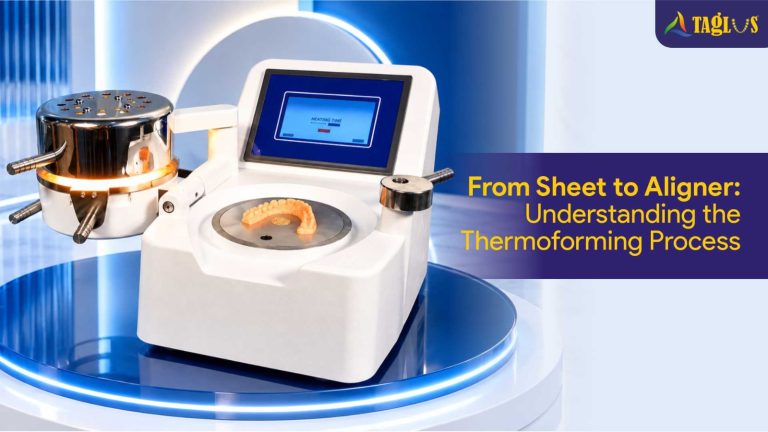
Thermoforming is one of those steps in aligner manufacturing that can look really simple. A sheet of material goes into a machine; it is heated and formed over a model, and it emerges as an aligner. But anyone who has been around production for long knows that the events between these steps are considerably more nuanced.
The process encompasses material science, machine performance, temperature control, model accuracy, and operator technique. And while it can be tempting to think of that as simply “shaping plastic,” in reality it has a great influence on how consistently an aligner performs.
This is worth thinking through, especially as dental labs move toward higher-volume production and increasingly automated workflows.
It Starts with a Sheet, but That is Not the Final Material
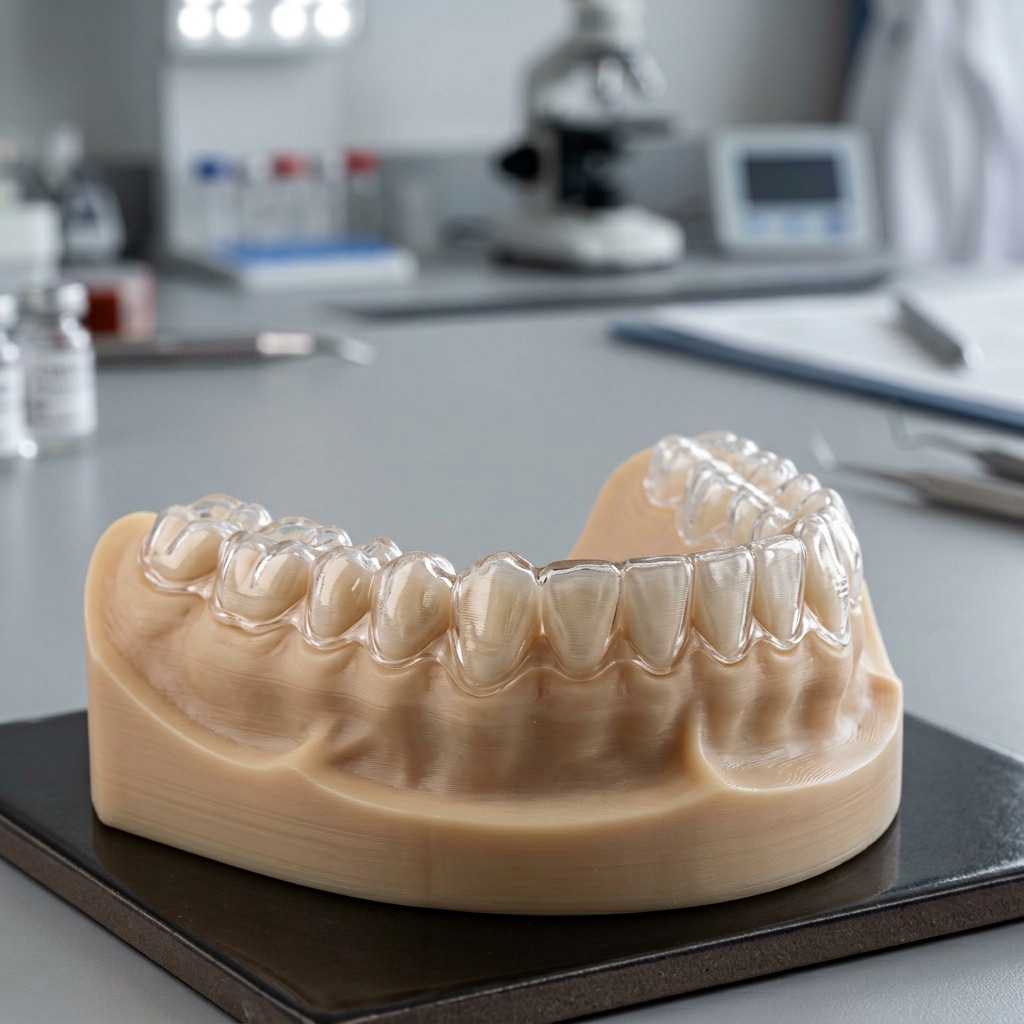
A thermoforming sheet is manufactured to a specific thickness and material composition. At this point, it can be characterized easily – thickness, clarity, flexibility, mechanical strength, etc. All of these can be measured under controlled conditions.
The interesting part happens when it is heated and formed.
Once the material is thermoformed over a dental model, it no longer has the same thickness distribution it started with. The sheet stretches as it adapts to the contours of the model, and that stretching is not uniform. Areas with greater curvature or deeper geometry experience more displacement than relatively flat surfaces.
So, when referring to a “0.75 mm aligner”, 0.75 mm refers to the specification that was given on the initial pre-thermoformed sheet, not necessarily the thickness of the finished aligner.
This distinction can be easy to overlook, but it becomes increasingly relevant when considering consistency.
Why Thermoforming Is More Than Just Heating and Forming
The basic principle of thermoforming is straightforward: heat a thermoplastic sheet until it is sufficiently pliable, bring it into contact with a model, apply vacuum and/or pressure, and allow it to cool on the model. After it has cooled, it has the desired shape and can be removed.
The practical reality is more dependent on manufacturing conditions.
Temperature, uniformity of heating, forming pressure, vacuum level, timing, material characteristics, model geometry, and cooling conditions all influence how it behaves. Even relatively small variations in these parameters affect how it adapts to the model.
This is one reason why simply specifying a material and a thickness does not tell the complete story of an aligner’s manufacturing process. Two labs could use the same sheet and produce noticeably different results. This happens when their thermoforming conditions are different.
The material is important. The machine is important. But the interaction between the two is where the complexity is.
Temperature Is Probably More Important Than It Looks
Heating a thermoforming sheet is not about making it “hot enough”.
The material needs to achieve an appropriate forming condition, and that condition needs to be relatively uniform across the sheet. If some areas are heated differently than others, it will not behave ideally when it is formed over the model.
Insufficient heating will make it less adaptable, while excessive or poorly controlled heating will change the way it stretches and behaves during forming.
This is why heating systems and temperature control are such important considerations when evaluating thermoforming equipment.
It is also why production parameters that work well for one material should not automatically be assumed to work identically for another. Different thermoplastic formulations can respond differently to heat, pressure, and cooling.
The Dental Model Matters Too
It is easy to focus entirely on the sheet and the machine and forget about the third component of the equation – the model.
In a digital aligner workflow, the physical model is generated from a digital treatment plan and is produced using 3D printing. That model effectively becomes the shape that the thermoformed material will reproduce.
Which means model accuracy, surface quality, dimensions, and geometry all matter.
If the model contains inaccuracies, surface imperfections, or dimensional inconsistencies, the thermoforming process does not magically correct them. The thermoform sheet is intended to follow the model, which means the quality of the model can become part of the quality of the final aligner.
This is where the broader digital workflow becomes important. Scan quality, treatment planning, 3D printing, thermoforming, and finishing are not completely independent stages. They influence one another.
What Happens to the Material During Forming?
When the sheet is heated, it becomes more pliable. As vacuum or pressure brings it against the dental model, the material stretches and conforms to the model’s geometry. Depending on the shape, some areas may experience considerably more stretching than others.
That means the finished aligner will have a non-uniform thickness distribution – even though it started as a sheet with relatively uniform thickness.
The degree of this change depends on different factors, including the original sheet thickness, its characteristics, model geometry, forming technique, and process conditions.
This is one reason why looking only at the nominal sheet thickness does not provide a complete picture of how the finished aligner will behave.
Vacuum or Pressure: Does It Really Make a Difference?
Different thermoforming systems take different approaches with the material. Vacuum forming uses negative pressure to draw the heated sheet toward the model. While pressure forming uses positive pressure to push it more closely against the model.
The choice of forming technology can influence adaptation, especially when working with detailed or complex model geometries.
But again, there is no single parameter that exists in isolation. A forming system needs to work appropriately with the selected material, heating conditions, and production workflow.
A sophisticated machine cannot compensate for unsuitable material handling, just as a high-quality sheet cannot overcome improper forming conditions.
Cooling Is Part of the Process, Not an Afterthought
Once the sheet has been formed, the process is not finished.
The material needs to cool and stabilize while retaining the geometry created during forming. The cooling stage is considered a part of the overall dimensional-control process.
Removing or handling it before it is sufficiently stabilized will introduce unwanted deformation or variation.
For high-volume aligner production, where the same steps are repeated hundreds or thousands of times, these seemingly small details become increasingly important.
And Then Comes Trimming
A thermoformed sheet is not yet an aligner.
After forming and cooling, excess material needs to be removed. The appliance is trimmed according to the intended design, and the edges may then be finished or polished.
In a manual environment, trimming can introduce operator-to-operator variation. In a more automated environment, dedicated trimming equipment helps to standardize the process, and thereby support higher production volumes.
The objective is not just to remove excess, but to create a consistent final geometry with an appropriate edge finish.
Why Process Consistency Becomes More Important as Production Scales
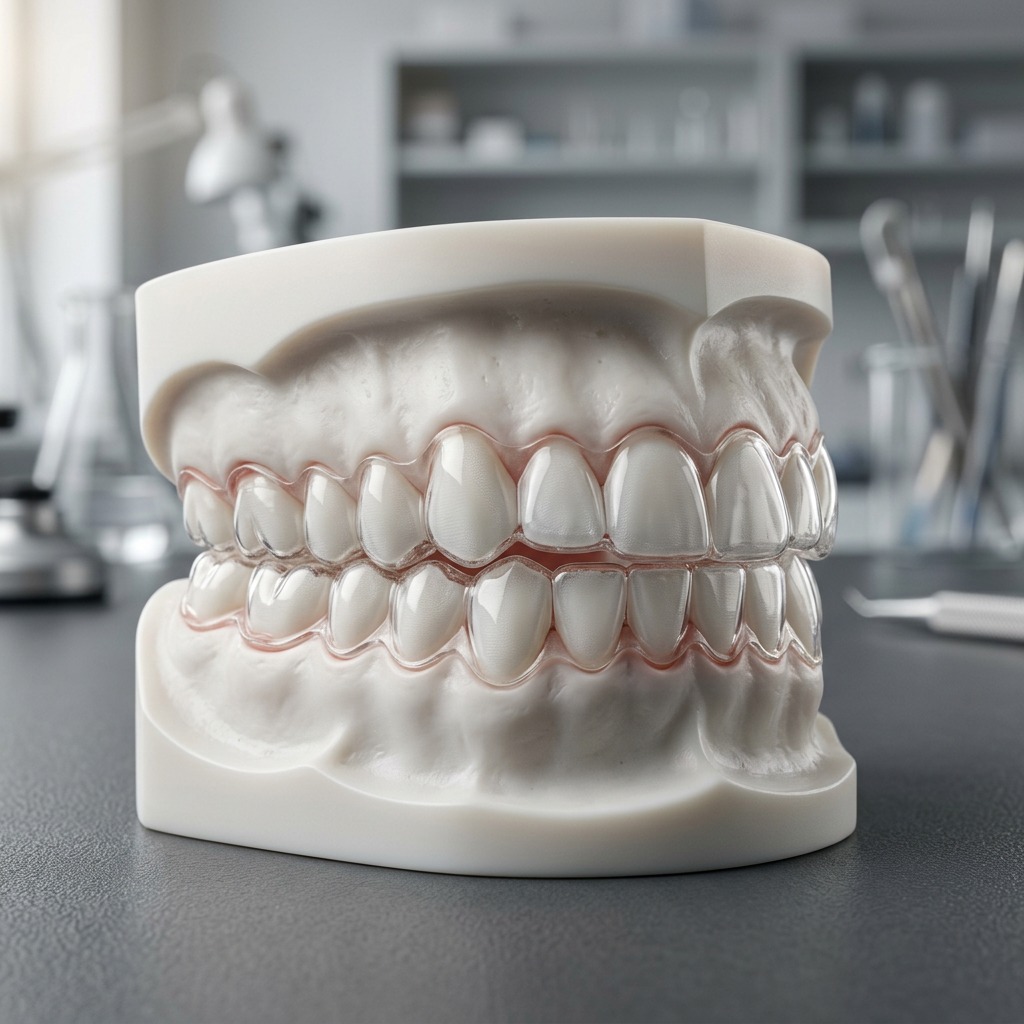
For a laboratory producing a handful of aligners, small variations in process conditions can be relatively easy to identify and correct. At higher production volumes, the same variations can become much more significant.
Imagine repeating the same thermoforming procedure hundreds of times. If heating varies slightly, if forming pressure changes, if cooling conditions are inconsistent, or if trimming differs from one operator to another, these small differences can add up across production.
This is where standardization becomes particularly valuable.
A scalable manufacturing workflow needs consistency not only in the material, but also in how it is processed.
From Digital Plan to Physical Aligner
The modern aligner workflow is therefore better understood as a connected chain rather than a collection of individual machines and processes.
Scan → Plan → Print → Form → Trim → Finish → Deliver
The digital scan provides the starting information. Treatment planning determines the intended tooth position, and 3D printing creates a physical model. Thermoforming transfers geometry to the sheet. Trimming and finishing turn the formed structure into the final appliance.
Every stage has its own role, but they are not completely independent.
The accuracy of one stage can influence what is possible in the next.
What Should Labs Look for in a Thermoforming Workflow?
There is no single specification that can define a good thermoforming setup. Rather, it is useful to look at the entire process.
Some practical considerations include:
- Material consistency: Is the sheet manufactured with consistent thickness and predictable properties?
- Heating control: Can the machine provide controlled and uniform heating?
- Forming performance: Does the machine provide consistent vacuum and/or pressure?
- Process repeatability: Can the same parameters be reproduced across multiple cycles?
- Workflow efficiency: Does the system support the laboratory’s production volume?
- Automation: Can repetitive steps be standardized where appropriate?
- Finishing: Is trimming and edge finishing integrated efficiently into the workflow?
These considerations become particularly relevant when a laboratory moves from small-scale production toward a more standardized manufacturing environment.
The Bigger Picture: Thermoforming Is One Part of the Ecosystem
It is tempting to look at thermoforming as the single moment when a sheet becomes an aligner. Technically, that is true. But from a manufacturing perspective, it is only one part of a much larger system.
The quality of the final aligner depends on how well materials, digital planning, 3D printing, thermoforming, trimming, and finishing work together.
That is also where the future of aligner manufacturing is heading towards. Connected workflows are increasingly seen in practice, where materials and equipment are designed to work together rather than being regarded as isolated components.
From Sheet to Aligner with Taglus
At Taglus, we look at thermoforming as part of the complete aligner manufacturing workflow—not simply as a machine operation.
From thermoforming sheets and dental materials to thermoforming equipment, 3D printing solutions, and trimming systems, the goal is to support a connected production environment where consistency can be maintained across every stage.
Because the journey from a flat sheet to a finished aligner involves much more than heat and pressure. It involves material science, process control, machine performance, and precision working together.
And ultimately, that is what turns a sheet into an aligner.
Want to explore the Taglus thermoforming ecosystem? Get in touch with our team to learn more about our materials and thermoforming solutions.
Have Questions?
 Talk to us on WhatsApp
Know More About Us
SignUp To Our Newsletter And Get To Know More About Taglus

Taglus is the global industry leader in the manufacturing of innovative clear Aligner and retainer thermoplastic sheets.

Copyrights@taglus-2026
*Taglus is a trademark of Vedia Solutions
Leave a Reply